2026-02-05 イェール大学
<関連情報>
- https://news.yale.edu/2026/02/05/beacons-were-lit-system-detect-and-map-merging-black-holes
- https://iopscience.iop.org/article/10.3847/2041-8213/ae3719
NANOGrav 15年データセット:超大質量ブラックホール連星の探査 The NANOGrav 15 yr Dataset: Targeted Searches for Supermassive Black Hole Binaries
Nikita Agarwal, Gabriella Agazie, Akash Anumarlapudi, Anne M. Archibald, Zaven Arzoumanian, Jeremy G. Baier, Paul T. Baker, Bence Bécsy, Laura Blecha, Adam Brazier,…
The Astrophysical Journal Letters Published: 2026 February 5
DOI:10.3847/2041-8213/ae3719
Abstract
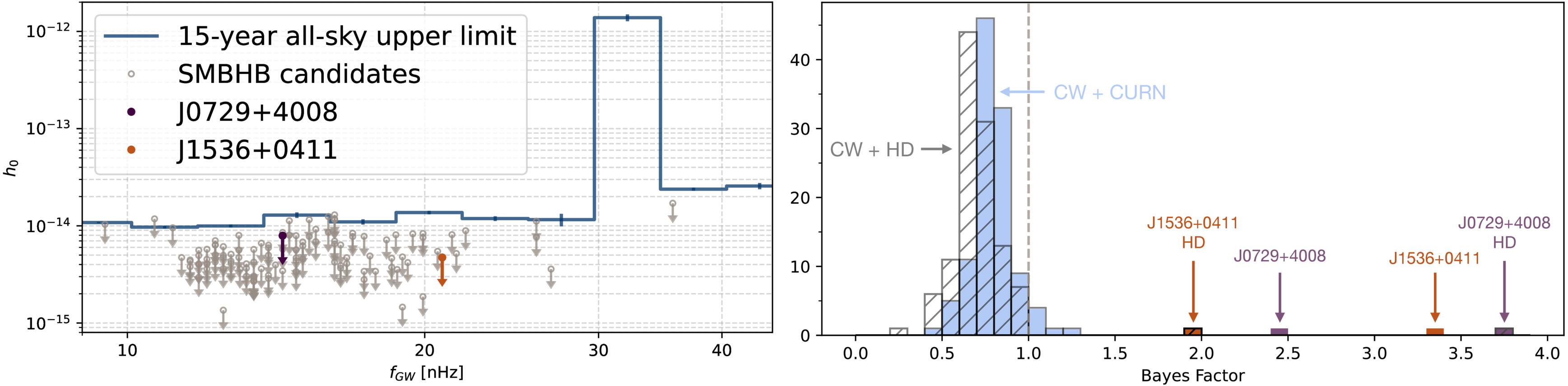
We present the first targeted searches for continuous gravitational waves (CWs) from 114 active galactic nuclei that may host supermassive black hole binaries, using the NANOGrav 15 yr dataset. By incorporating electromagnetic priors on sky location, distance, redshift, and CW frequency, our strain and chirp-mass upper limits are typically improved by a factor of ∼2 (median 2.2) relative to all-sky limits at the same frequency. Bayesian comparisons against a model including only a Hellings–Downs-correlated background disfavors a CW signal for all targets, with a mean Bayes factor of 0.73 ± 0.32. Two targets have Bayes factors slightly above unity, but coherence tests, random-targeting experiments, and a conservative accounting of the 114-target trials factor all indicate that they are consistent with noise. We use these two candidates as worked examples to illustrate an end-to-end targeted CW search analysis and a suite of follow-up tests that future promising candidates would need to pass. We find that the electromagnetic interpretations of both candidates are ambiguous, and we update the constraints on a putative binary in 3C 66B, ruling out part of its previously allowed parameter space. Ultimately, our results demonstrate the current sensitivity of targeted pulsar timing array searches for CWs and define a road map for future multimessenger CW detections.