2026-02-05 チャルマース工科大学
<関連情報>
- https://news.cision.com/chalmers/r/humidity-resistant-hydrogen-sensor-can-improve-safety-in-large-scale-clean-energy,c4302565
- https://pubs.acs.org/doi/10.1021/acssensors.5c03166
高湿度環境における水素検出のための触媒プラズモニックPtナノ粒子センサー A Catalytic-Plasmonic Pt Nanoparticle Sensor for Hydrogen Detection in High-Humidity Environments
Athanasios Theodoridis,Carl Andersson,Sara Nilsson,Joachim Fritzsche,and Christoph Langhammer
ACS Sensors Published November 18, 2025
DOI:https://doi.org/10.1021/acssensors.5c03166
Abstract
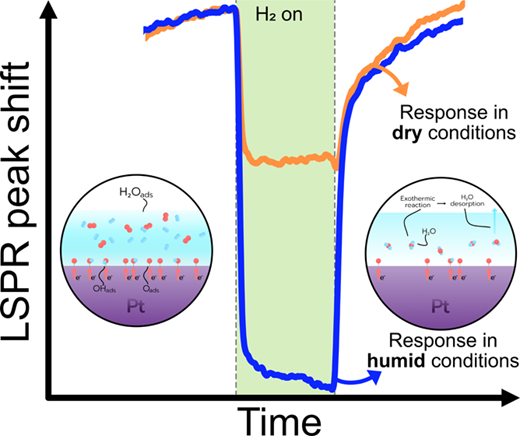
The detection of hydrogen gas in humid air environments is a key unresolved challenge for hydrogen safety in the rapidly growing hydrogen energy technologies, which hold a key to abate the CO2 emissions from particularly challenging sectors that together represent more than 20% of man-made CO2. In this work, we introduce a catalytic-plasmonic optical hydrogen sensor that employs nanofabricated and plasmonically active Pt nanoparticles as transducer elements for hydrogen detection in highly humid environments in air. Leveraging the combination of the Pt nanoparticles’ intrinsic high activity in the catalytic hydrogen oxidation reaction with their high sensitivity in plasmonic dielectric sensing, we show that this catalytic-plasmonic sensor is able to operate in the entire humidity range of 0–80% relative humidity accessible in our test setup and exhibits a measured limit of detection of 30–50 ppm hydrogen in air at 100 °C and 80 °C sensor operating temperatures, respectively, and that it delivers consistent and constant response to hydrogen during a 143 h long continuous measurement in 80% relative humidity. We also show that above a given hydrogen concentration, the sensor response magnitude to a specific hydrogen concentration increases with increasing humidity, which is the distinct opposite of any other known hydrogen sensing technology, whose response deteriorates or is entirely suppressed in high humidity. This advertises catalytic-plasmonic sensors as a new paradigm in the hydrogen sensor arena with particular promise for hydrogen detection in high-humidity environments.