2026-02-02 ペンシルベニア州立大学(Penn State)
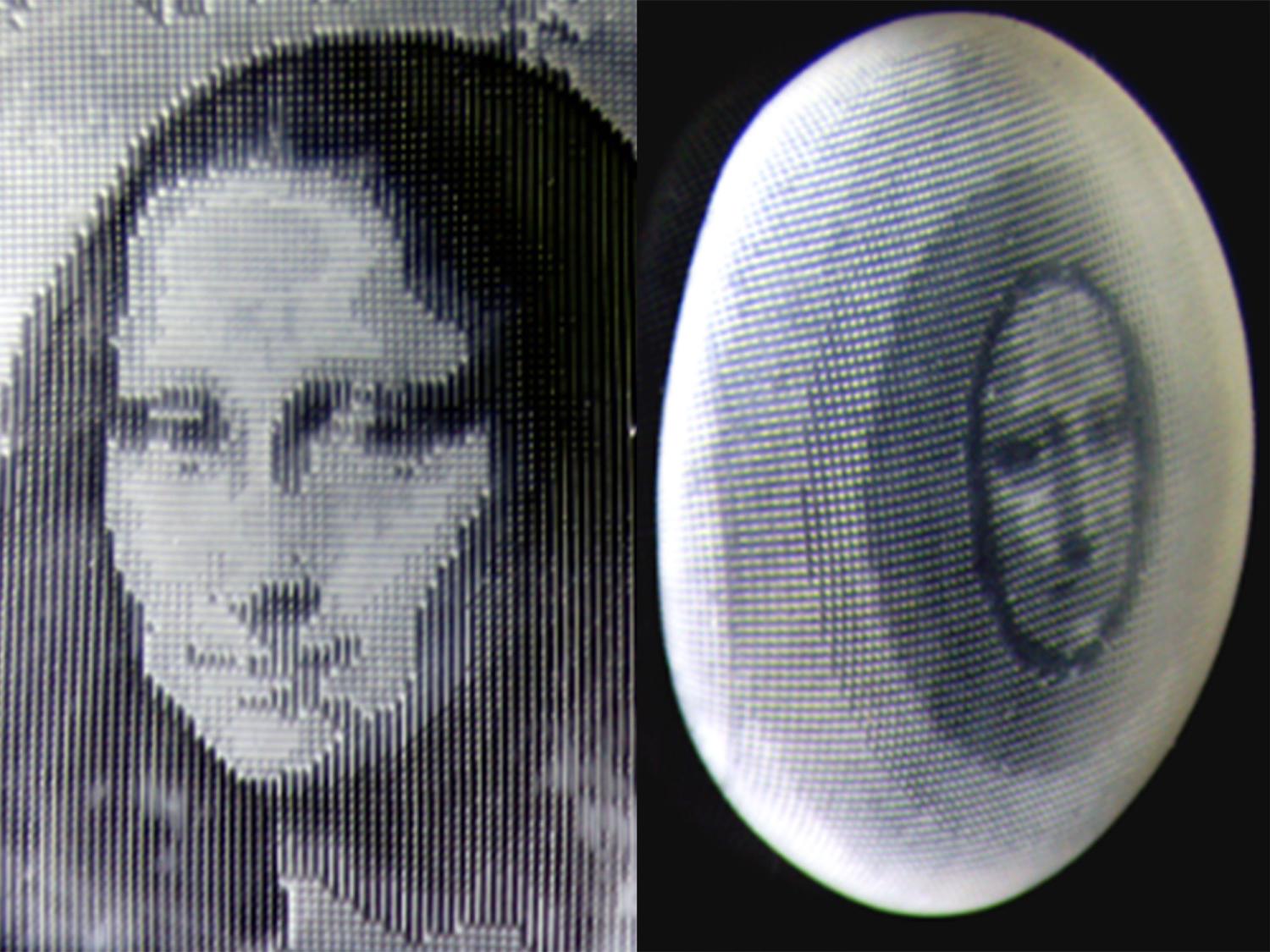
The team used their new printing method to encode a photo of the Mona Lisa onto their “smart skin” material (left). The photo, which can initially appear hidden in the material, can be revealed by stretching, exposure to heat, exposure to liquid or by adjusting the material from a 2D to a 3D shape (right). Credit: Provided by Hongtao Sun. All Rights Reserved.
<関連情報>
- https://www.psu.edu/news/research/story/team-develops-smart-synthetic-material-inspired-octopus-skin
- https://www.nature.com/articles/s41467-025-65378-8
- https://www.nature.com/articles/s41467-024-53552-3
頭足動物に着想を得た合成スマートスキンのための刺激再構成可能なバイナリドメインのハーフトーンエンコード4Dプリント Halftone-encoded 4D printing of stimulus-reconfigurable binary domains for cephalopod-inspired synthetic smart skins
Haoqing Yang,Haotian Li,Juchen Zhang,Tengxiao Liu,H. Jerry Qi & Hongtao Sun
Nature Communications Published:12 November 2025
DOI:https://doi.org/10.1038/s41467-025-65378-8
Abstract
Cephalopods exhibit versatile control over their optical appearance, texture, and shape for adaptive camouflage and signaling. Achieving such multi-feature dynamic control in synthetic materials remains a significant challenge. Here, we introduce a halftone-encoded 4D printing method that enables simultaneous and programmable control over optical appearance, mechanical properties, surface texture, and shape transformation within a single smart hydrogel film in response to various external stimuli (e.g., temperature, solvents, and mechanical stress)—a capability beyond existing synthetic materials. By encoding halftone binary patterns composed of highly crosslinked (“1”) and lightly crosslinked (“0”) domains, we spatially regulate localized polymer-solvent interactions and microstructural heterogeneities. The interplay, arrangement, and integration of these binary domains collectively dictate macroscale multifunctionality within a single material system. This binary encoding approach offers a simple yet powerful platform for designing multifunctional synthetic materials with complex, reconfigurable behaviors, unlocking opportunities in soft robotics, adaptive surface engineering, and secure information storage.
異種サブドメインの操作によるスマートハイドロゲルのカスタマイズ Tailoring smart hydrogels through manipulation of heterogeneous subdomains
Haoqing Yang,Tengxiao Liu,Lihua Jin,Yu Huang,Xiangfeng Duan & Hongtao Sun
Nature Communications Published:27 October 2024
DOI:https://doi.org/10.1038/s41467-024-53552-3
Abstract
The mechanical interactions among integrated cellular structures in soft tissues dictate the mechanical behaviors and morphogenetic deformations observed in living organisms. However, replicating these multifaceted attributes in synthetic soft materials remains a challenge. In this work, we develop a smart hydrogel system featuring engineered stiff cellular patterns that induce strain-driven heterogeneous subdomains within the hydrogel film. These subdomains arise from the distinct mechanical responses of the pattern and film domains under applied mechanical forces. Unlike previous studies that incorporate reinforced inclusions into soft matrices to tailor material properties, our method manipulates the localization, integration, and interaction of these subdomain building blocks within the soft film. This enables extensive tuning of both local and global behaviors. Notably, we introduce a subdomain-interface mechanism that allows for the concurrent customization and decoupling of mechanical properties and shape transformations within a single material system—an achievement rarely accomplished with current synthetic soft materials. Additionally, our use of in-situ imaging characterizations, including full-field strain mapping via digital imaging correlation and reciprocal-space patterns through fast Fourier transform analysis of real-space pattern domains, provides rapid real-time monitoring tools to uncover the underlying principles governing tailored multiscale heterogeneities and intricate behaviors.