2026-01-28 NASA
<関連情報>
- https://www.nasa.gov/missions/chandra/nasa-telescopes-spot-surprisingly-mature-cluster-in-early-universe/
- https://www.nature.com/articles/s41586-025-09973-1
Z ≈ 5.7のX線放射原始銀河団は急速な構造成長を明らかにした An X-ray-emitting protocluster at z ≈ 5.7 reveals rapid structure growth
Ákos Bogdán,Gerrit Schellenberger,Qiong Li & Christopher J. Conselice
Nature Published:28 January 2026
DOI:https://doi.org/10.1038/s41586-025-09973-1
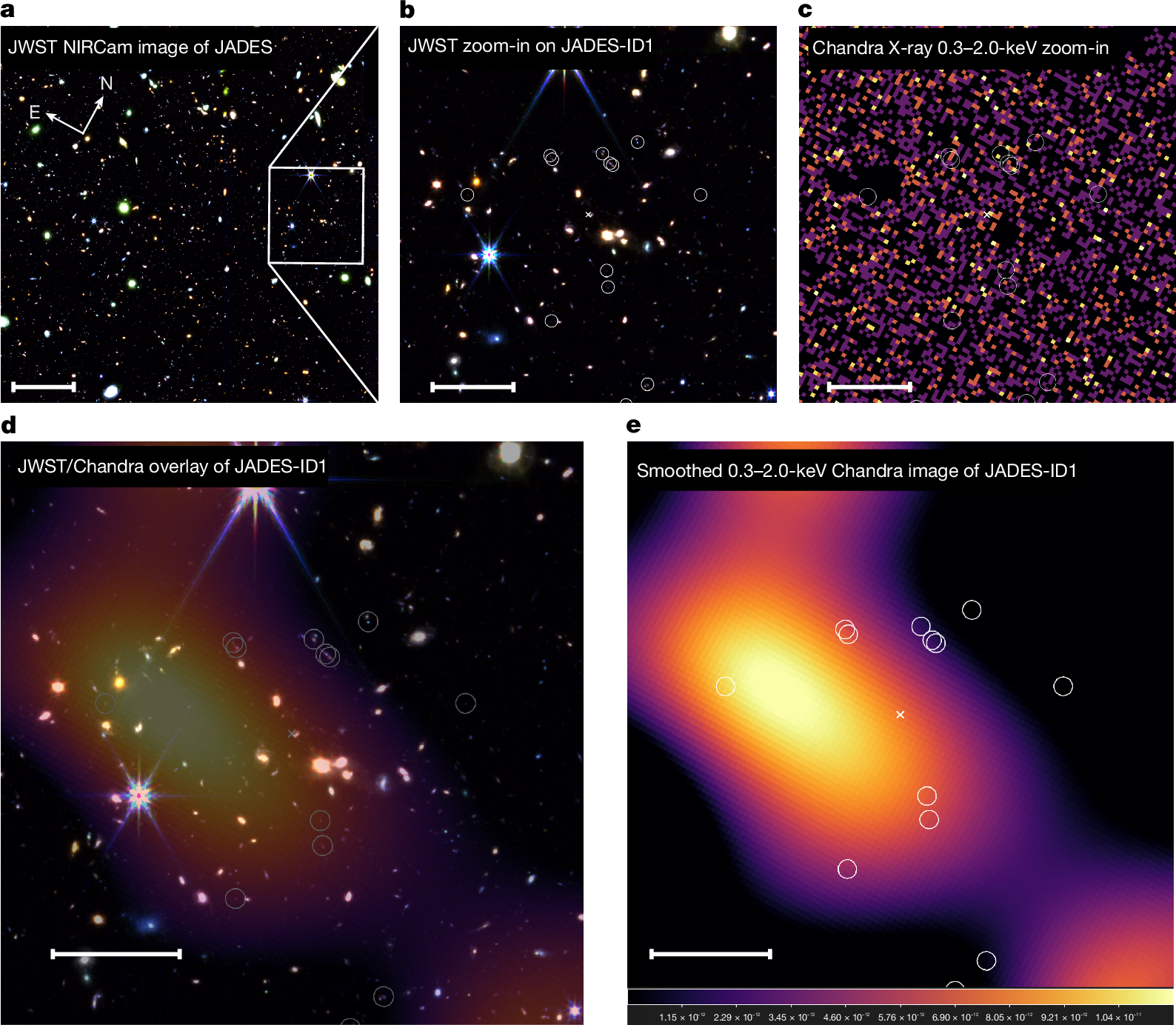
Abstract
Galaxy clusters are the most massive gravitationally bound structures in the universe and serve as tracers of the assembly of large-scale structure1. Studying their progenitors, protoclusters, sheds light on the earliest stages of cluster formation. However, detecting protoclusters is demanding: their member galaxies are loosely bound and the emerging hot intracluster medium (ICM) may only be in the initial stages of virialization2,3,4. Recent James Webb Space Telescope (JWST) observations located several protocluster candidates by identifying overdensities of z ≳ 5 galaxies5,6,7,8,9. However, none of these candidates was detected by X-ray observations, which offer a powerful way to unveil the hot ICM. Here we report the combined Chandra and JWST detection of a protocluster, JADES-ID1, at z ≈ 5.68, merely one billion years after the Big Bang. We measure a bolometric X-ray luminosity of Lbo1= (1.5+0.5-0.6)×1044ergs-1 and infer a total gravitating mass of M500= (1.8+0.6-0.7)×1013M⦿, making this system a progenitor of today’s most massive galaxy clusters. The detection of extended, shock-heated gas indicates that substantial ICM heating can occur in massive halos as early as z ≈ 5.7. Also, given the limited survey volume, the discovery of such a massive cluster is statistically unlikely10, implying that the formation of the large-scale structure must have occurred more rapidly in some regions of the early universe than standard cosmological models predict.