2026-01-26 中国科学院(CAS)
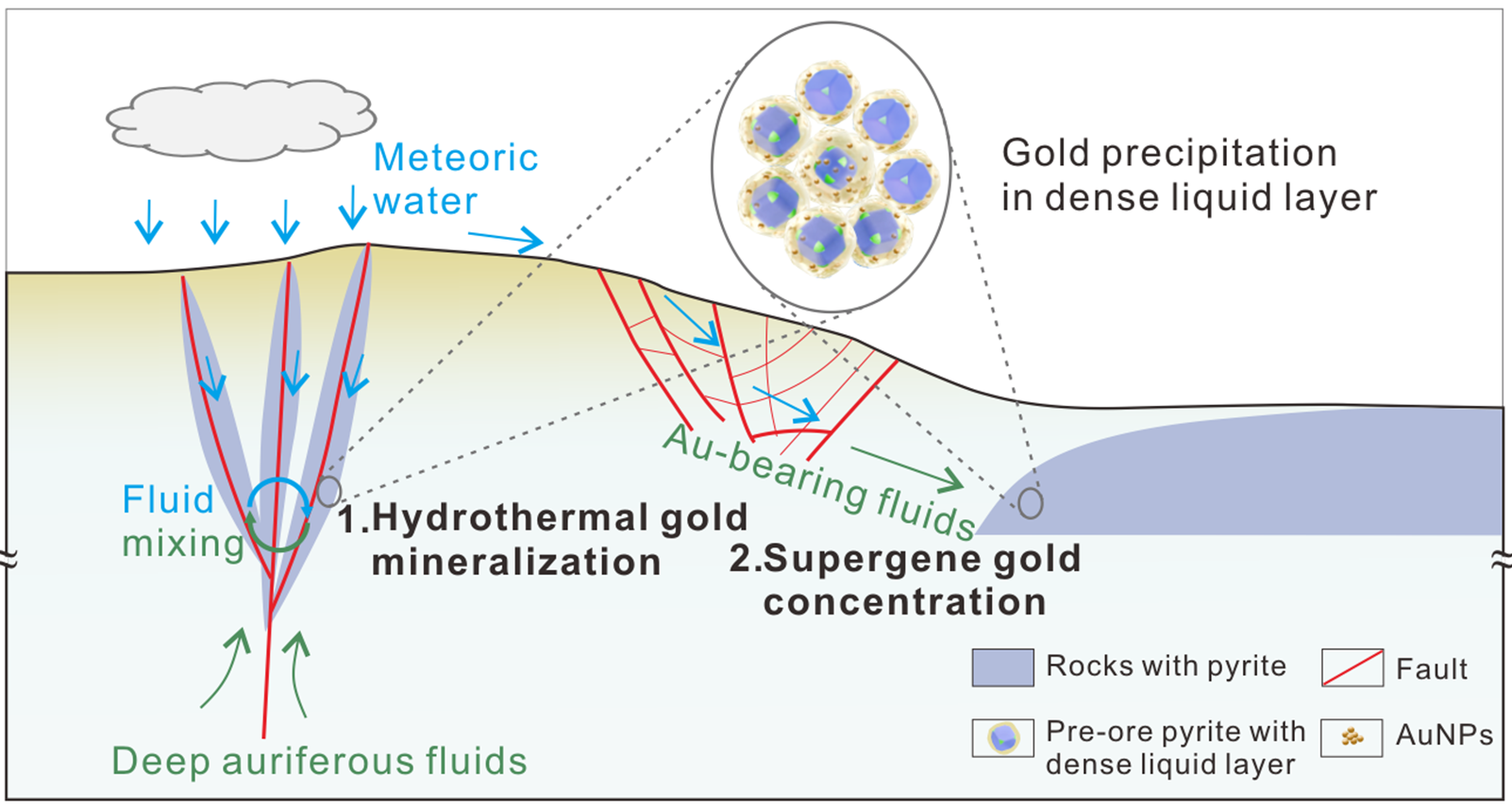
Schematic diagram of gold enrichment in the dense liquid layer during hydrothermal mineralization and supergene concentration. (Image by ZHU Jianxi and XIAN Haiyang’s team)
<関連情報>
- https://english.cas.cn/newsroom/research-news/202602/t20260210_1150355.shtml
- https://www.pnas.org/doi/10.1073/pnas.2517918123
黄鉄鉱と水の界面における高密度液体層中の金の析出のその場観察 In situ observations of gold deposition in a dense liquid layer at the pyrite–water interface
Hongmei Tang, Haiyang Xian, Teng Deng, +7 , and Hongping He
Proceedings of the National Academy of Sciences Published:January 22, 2026
DOI:https://doi.org/10.1073/pnas.2517918123
Significance
The adsorption and reduction of gold ions on pyrite surfaces cause the formation of gold nanoparticles (AuNPs) and induce efficient gold precipitation. However, the nucleation mechanisms and growth kinetics of AuNPs at the pyrite–water interface still remain unclear. Based on the observations of in situ liquid cell transmission electron microscopy, this study reveals the role of dense liquid layer formed at the pyrite–water interface in the nucleation and growth of AuNPs. Our findings help to elucidate the surface chemical effects of pyrite and other sulfides on gold migration and enrichment. Such a mechanism enables the superenrichment of gold by pyrite from dilute gold-bearing fluids, challenging the conventional view that gold is primarily sourced from deep hydrothermal fluids.
Abstract
Pyrite-triggered precipitation of gold nanoparticles (AuNPs) is crucial for generating high-grade gold deposits, yet its dynamic process and mechanism at the pyrite–water interface remain unclear due to the lack of in situ observation. Here, utilizing in situ liquid cell transmission electron microscopy, we find a dense liquid layer mediated deposition of AuNPs at the pyrite–water interface in parts per billion-level gold-bearing solutions, a concentration that resembles crustal abundances. Real-time imaging reveals that a dense liquid layer forms at the pyrite–water interface, and it is proposed that AuNPs nucleate and grow in this layer. Results from in situ atomic force microscopy and ex situ transmission electron microscopy indicate that the growth kinetic process of AuNPs involves monomer-to-cluster aggregation, further enriching gold at the pyrite–water interface. Thermodynamic modeling demonstrates that precipitation of AuNPs is primarily driven by the oxygen fugacity decrease in the dense liquid layer due to pyrite dissolution. These findings reveal a localized gold concentration mechanism to interpret adsorption and nucleation of AuNPs on pyrite during its dissolution–precipitation cycles, which significantly enhances our understanding of the highly effective gold scavenging from fluid by pyrite. The mechanism of nanoparticle formation in the dense liquid layer at dissolving mineral–fluid interfaces represents a fundamental process that could be common in nature.