2026-01-16 東北大学
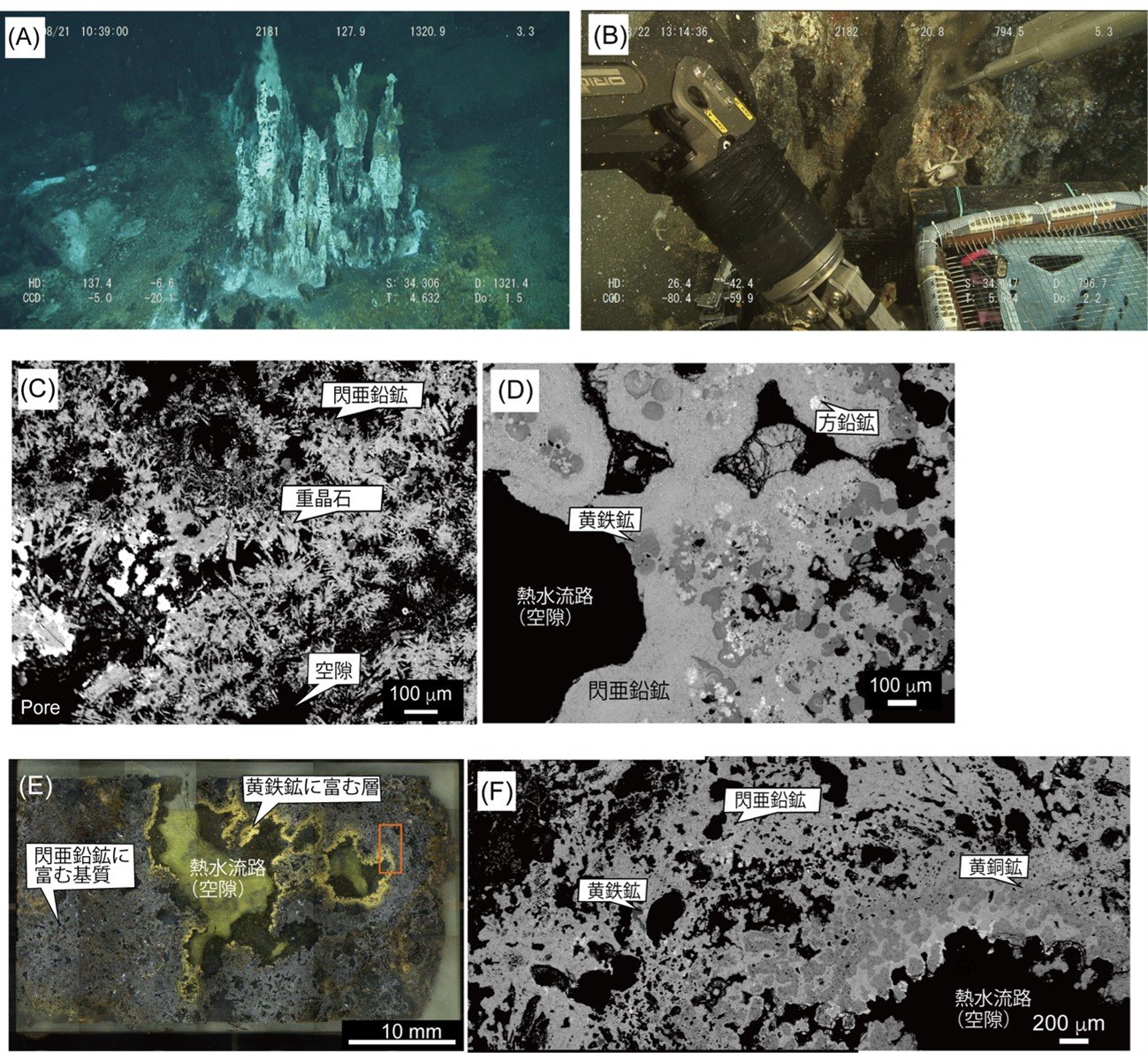
図1. 伊豆・小笠原海域の熱水噴出孔のチムニーの産状と鉱物組織。(A)水深1332mの海底で観察される活発に熱水を噴出しているチムニー。(B)海底で熱水の温度計測をしている様子。熱水噴出孔の周辺にカニが生息している。(C)若いチムニーの電子顕微鏡写真。重晶石に富み空隙が多い。(D)閃亜鉛鉱が主体の緻密なチムニー。(E, F)成熟したチムニー試料の断面の写真(E)とその電子顕微鏡写真(F)。熱水流路周りに黄銅鉱に富む層ができている。電子顕微鏡写真の黒色部分は熱水流路(空隙)を示す。
<関連情報>
- https://www.tohoku.ac.jp/japanese/2026/01/press20260116-01-chimney.html
- https://www.tohoku.ac.jp/japanese/newimg/pressimg/tohokuuniv-press20260116_01web_chimney.pdf
- https://pubs.geoscienceworld.org/gsa/geology/article/doi/10.1130/G53463.1/724089/Self-organized-thermoelectric-conversion-systems
深海底における自己組織化熱電変換システム
Self-organized thermoelectric conversion systems on the deep seafloor
Atsushi Okamoto;Misaki Takahashi;Yoshinori Sato;Ryoichi Yamada;Kentaro Toda;Tomonori Ihara;Tatsuo Nozak
Geology Published:January 08, 2026
DOI:https://doi.org/10.1130/G53463.1
Deep-sea hydrothermal vents are sites where thermal energy from Earth’s interior is emitted into the ocean, and sulfide- or sulfate-rich chimneys form by mixing of hydrothermal fluids and ambient cold seawater. Sulfide minerals are semiconductors and can convert thermal to electrical energy. However, regardless of the high-temperature difference (up to 400 °C) between vent fluids and seawater, the significance of thermoelectric power generation by chimneys is poorly understood. We measured the electrical conductivity and thermoelectromotive force (TEMF) of typical sulfide minerals and each part of zoned chimney walls from seafloor hydrothermal vents to evaluate their thermoelectric conversion. Young and porous chimneys consist mainly of fine-grained sulfate and Zn sulfide, with extremely low electrical conductivity, resulting in no thermoelectric conversion. In contrast, mature chimneys with inner walls rich in Cu, Fe, and Pb sulfides are n-type semiconductors with a high thermoelectric conversion performance. Given a temperature difference of 200−300 °C between the vent fluids and ambient seawater, the TEMF of the mature chimneys approaches 10−210 mV, which is comparable to the redox potential between vent fluids and seawater (∼500 mV). This TEMF could play an essential role as a power source to overcome the overpotential required for the redox reactions at both sides of the chimney walls. Our findings suggest that seafloor chimneys are a unique self-organized thermoelectric conversion system that supplies substantial electrical energy to deep-sea ecosystems.