2026-01-16 京都大学
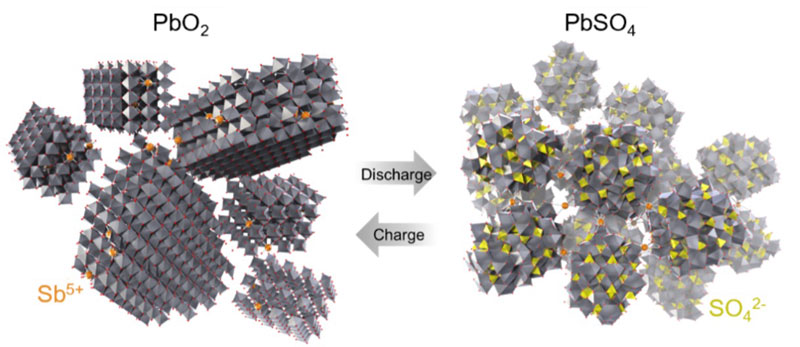
本研究の概要図:鉛蓄電池正極において、充放電に伴いアンチモンが二酸化鉛格子へ可逆的に取り込まれ、放電時には粒子表面で構造安定化に寄与する様子を、放射光X線を用いたマルチスケール解析で捉えている。
<関連情報>
- https://www.kyoto-u.ac.jp/ja/research-news/2026-01-16
- https://www.kyoto-u.ac.jp/sites/default/files/2026-01/web_2601_Uchimoto-4dfc8bceeb69582cb3c01531f24d6845.pdf
- https://pubs.acs.org/doi/10.1021/acsomega.5c11008
定量的シンクロトロンXRDと極低温EXAFSにより鉛蓄電池におけるアンチモンイオンの構造的役割が明らかに Quantitative Synchrotron XRD and Cryogenic EXAFS Reveal the Structural Role of Antimony Ions in Lead–Acid Batteries
Yoshiki Hayakawa,Ikumi Ban,Yoshiaki Yamaguchi,Toshiki Watanabe,Toshiyuki Matsunaga,and Yoshiharu Uchimoto
ACS Omega Published: January 14, 2026
DOI:https://doi.org/10.1021/acsomega.5c11008
Abstract
The incorporation of trace amounts of Sb2O3 into the positive electrode plate of lead–acid batteries effectively suppresses the softening and shedding of the active material, thereby extending the cycle life. Although this beneficial effect has been recognized for decades, its mechanistic origin has remained elusive owing to the ultratrace concentration of antimony (Sb), which prevents detection by conventional techniques. Here, we combine quantitative multicomponent analysis by synchrotron X-ray diffraction (XRD) with cryogenic (10 K) extended X-ray absorption fine structure (EXAFS) spectroscopy to directly probe the structural role of Sb ions during charge–discharge cycling. Quantitative XRD analysis reveals that during formation, Sb ions are substitutionally incorporated into Pb sites within the PbO2 lattice. Cryogenic EXAFS measurements further demonstrate that during discharge, as PbO2 converts into PbSO4, a fraction of the Sb ions appear to migrate from the PbO2 lattice toward particle surfaces, where they reinforce interparticle bonding. This reversible incorporation and surface relocation of Sb ions account for the observed stabilization of the active material and suppression of softening and shedding. Our findings highlight how advanced synchrotron-based techniques enable direct mechanistic insight at the atomic scale, providing critical guidance for the rational design of next-generation lead–acid batteries with enhanced performance and reduced environmental impact.