2026-01-09 産業技術総合研究所
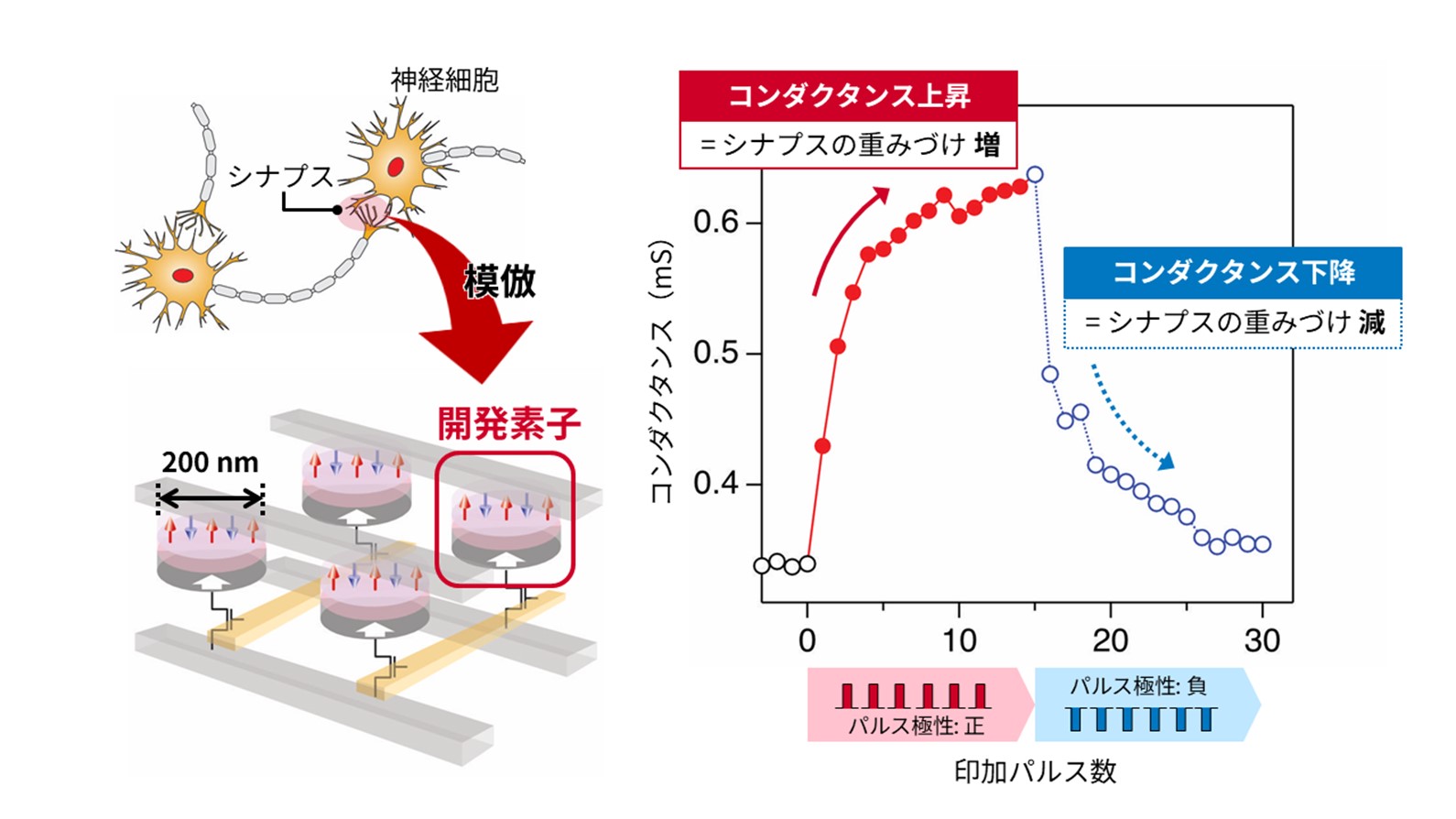
本研究で開発した磁気メモリスタの概念図と、磁気メモリスタでシナプスの機能を模倣した例
※原論文の図を引用・改変したものを使用しています。
<関連情報>
- https://www.aist.go.jp/aist_j/press_release/pr2026/pr20260109/pr20260109.html
- https://advanced.onlinelibrary.wiley.com/doi/abs/10.1002/adfm.202523154
スピノーダル磁気抵抗メモリスタ Spinodal Magnetoresistive Memristors
Tatsuya Yamamoto, Tomohiro Ichinose, Jun Uzuhashi, Sumito Tsunegi, Takayuki Nozaki, Tadakatsu Ohkubo, Shingo Tamaru, Kay Yakushiji, Hitoshi Kubota, Shinji Yuasa
Advanced Functional Materials Published: 08 January 2026
DOI:https://doi.org/10.1002/adfm.202523154
Abstract
Spinodal decomposition is a phenomenon that forms self-assembled microstructures with extremely uniform sizes and shapes. The phenomenon is exploited in the manufacture of alnico magnets, once considered to be the strongest permanent magnets. However, it has hardly been used in spintronics, one of the most important applications of magnetic materials today, because conventional spintronic devices require uniform magnetic thin-films to achieve a single-domain state. Here, the study sheds light on how spinodal magnets can be used to create high-performance spintronics memristors that have synaptic functionalities. Thin-film spinodal decomposition is used to fabricate an Fe-Mn-based storage layer with a nanostructure consisting of Fe-rich granules in magnetic tunnel junctions. The devices function as nanoscale memristors that offer both long-term data retention and analog-like resistance changes controlled by nanosecond voltage pulses and emulate fundamental synaptic functionalities. The results indicate that spinodal MTJs will be a key to realizing nanoscale memristors for energy-efficient neuromorphic computing.