2025-12-18 シカゴ大学
<関連情報>
- https://pme.uchicago.edu/news/ai-advisor-helps-self-driving-labs-share-control
- https://www.nature.com/articles/s44286-025-00318-3
自律的な電子材料発見のための適応型AI意思決定インターフェース Adaptive AI decision interface for autonomous electronic material discovery
Yahao Dai,Henry Chan,Aikaterini Vriza,Jingyuan Fan,Fredrick Kim,Yunfei Wang,Wei Liu,Naisong Shan,Jing Xu,Max Weires,Yukun Wu,Zhiqiang Cao,C. Suzanne Miller,Ralu Divan,Xiaodan Gu,Chenhui Zhu,Sihong Wang & Jie Xu
Nature Chemical Engineering Published:18 December 2025
DOI:https://doi.org/10.1038/s44286-025-00318-3
Abstract
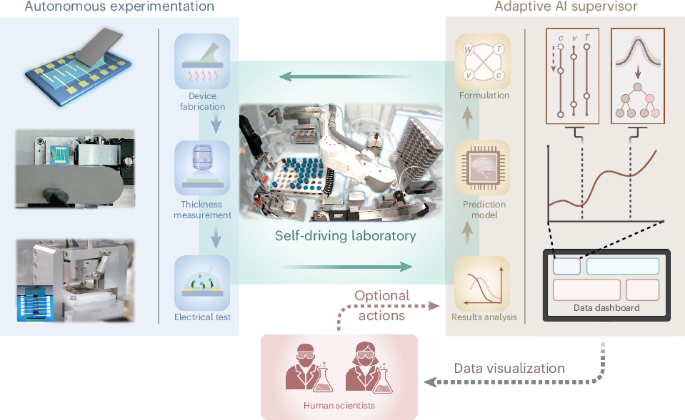
Artificial intelligence (AI)-powered autonomous experimentation (AE) accelerates materials discovery, but its use for electronic materials is limited by data scarcity from lengthy and complex design–fabricate–test–analyze cycles. Unlike human scientists, even current advanced AI–AE systems lack the adaptability for informative, real-time decisions with limited datasets. Here we developed an AI decision interface featuring an AI advisor for real-time monitoring, analysis and interactive human–AI collaboration, enabling active adaptation to different experimental stages and types. We applied this platform to an important class of electronic materials, mixed ion–electron conducting polymers, to study multiscale morphology and properties. Using organic electrochemical transistors to evaluate the mixed-conducting figure of merit, defined as the product of charge-carrier mobility and volumetric capacitance (μC*), our platform achieved a broad μC* range from 166 to 1,275 F cm−1 V−1 s−1 in just 64 autonomous trials. The analysis identified two key structural factors for higher volumetric capacitance: larger crystalline lamellar spacing and higher specific surface area, and uncovered a previously unknown polymer polymorph.