2025-12-09 中国科学院(CAS)
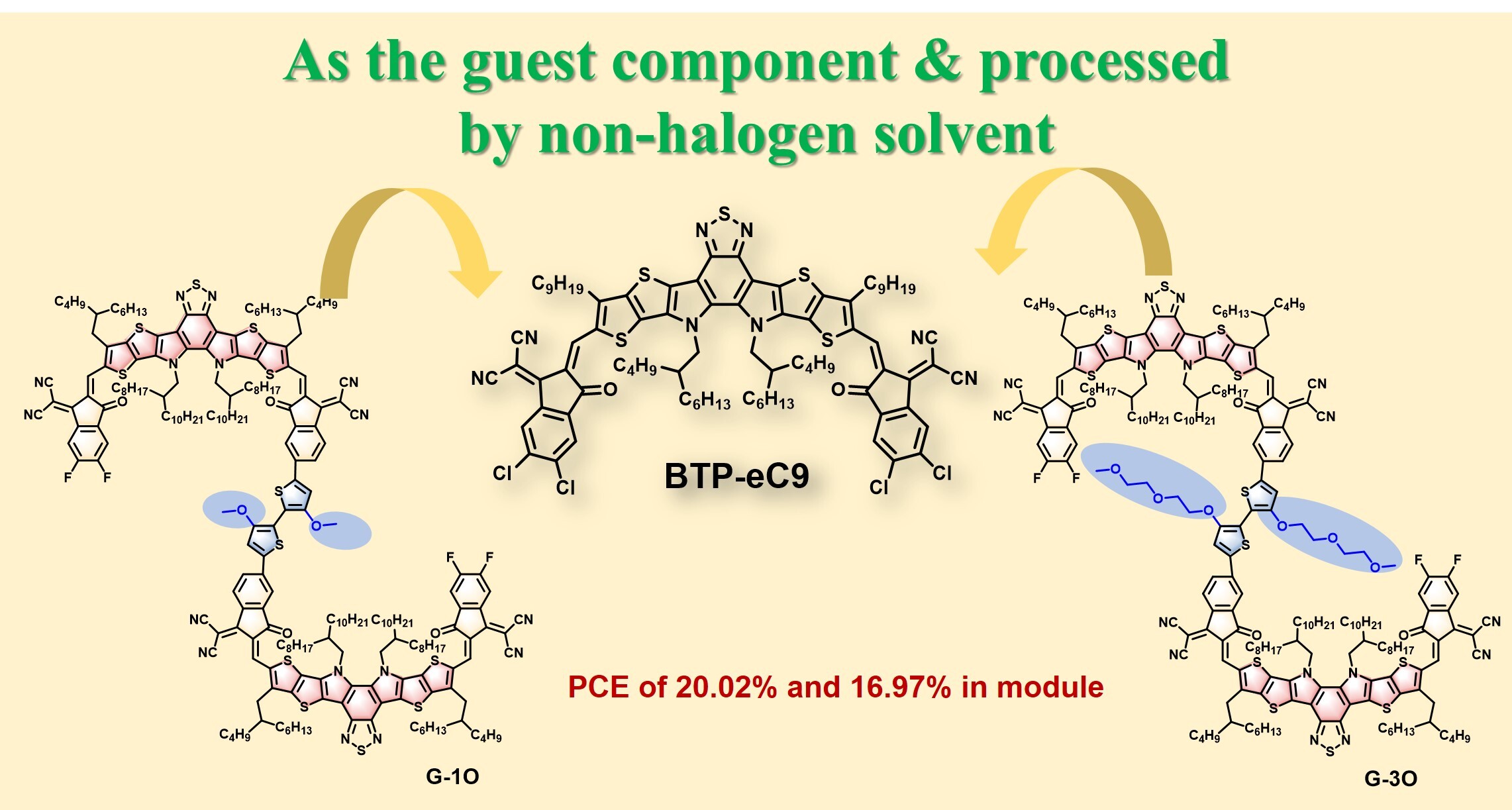
The chemical structures of the designed guest component and BTP-eC9. (Image by NIMTE)
<関連情報>
- https://english.cas.cn/newsroom/research_news/tech/202512/t20251210_1135887.shtml
- https://advanced.onlinelibrary.wiley.com/doi/10.1002/adma.202511584
新規酸素化リンカーを有する巨大アクセプターが分子結晶化速度を調節し、高効率非ハロゲン処理有機太陽電池を実現する A Giant Acceptor with a Novel Oxygenated Linker Modulates Molecular Crystallization Kinetics for High-Efficiency Non-Halogenated-Processed Organic Solar Cells
Lin Xie, Pengfei Ding, Xueliang Yu, Xiaoqi Yu, Daobin Yang, HaoTian Hu, Tongqiang Liu, Qirui Zhang, Jinsheng Zhang, Ze Jing, Zhenxin Shao, Jintao Zhu, Zhenyu Chen, Xuke Li, Juanfang Xu …
Advanced Materials Published: 24 November 2025
DOI:https://doi.org/10.1002/adma.202511584
Abstract
The use of low-boiling-point halogenated solvents is common in lab-scale organic solar cell (OSC) fabrication to achieve high power conversion efficiencies (PCEs), but their high volatility hinders large-scale fabrication. High-boiling-point, non-halogenated solvents are adopted as alternatives, but they often result in significant efficiency losses due to inferior morphology. In this work, toluene is adopted, enabling scalable production without any post-treatment. Two giant guest acceptors, featuring distinct oxygenated side chains, are introduced to modulate pre-aggregation in solution and crystallization kinetics within the PM6:BTP-eC9 blend. The incorporation of giant acceptors effectively inhibits rapid acceptor aggregation and promotes smaller phase separation. Moreover, G-1O with a shorter oxygenated side chain yields more homogeneous phase separation, whereas G-3O with a longer side chain leads to uneven separation. Therefore, the G-1O-based ternary device achieves an outstanding PCE of 20.02%. Notably, a high PCE of 16.97% is also obtained in a large-area module (15.6 cm2, without dead zone). These findings highlight the critical role of oxygenated side-chain engineering in guest molecules for tuning crystallization kinetics under toluene processing.