2025-12-05 京都大学
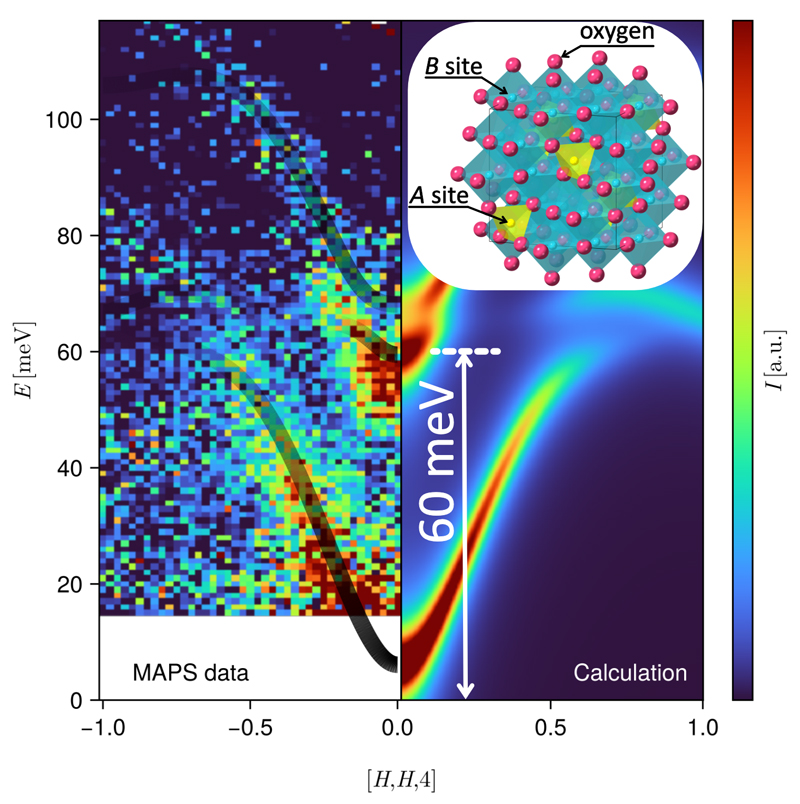
MAPS 分光器で測定されたCoFe₂O₄のスピン波スペクトル(左)と、それに対応するスピン波計算(右)。約60 meVに及ぶ二つのマグノン分散の大きな分裂は、挿入図の結晶構造に示すように、AサイトとBサイトの陽イオンに作用する分子場が強く不均衡であることに起因している。(作成:南部雄亮)
<関連情報>
- https://www.kyoto-u.ac.jp/ja/research-news/2025-12-05-0
- https://www.kyoto-u.ac.jp/sites/default/files/2025-12/web_2512_Nambu-791320ff8a0297e0508984740fbfcfef.pdf
- https://advanced.onlinelibrary.wiley.com/doi/10.1002/adfm.202516830
磁歪性CoFe2O4における異方性バンドスプリット磁性 Anisotropic Band-Split Magnetism in Magnetostrictive CoFe2O4
Harry Lane, Guratinder Kaur, Masahiro Kawamata, Yusuke Nambu, Lukas Keller, Russell A. Ewings, David J. Voneshen, Travis J. Williams, Helen C. Walker, Dwight Viehland, Peter M. Gehring, Chris Stock
Advanced Functional Materials Published: 12 November 2025
DOI:https://doi.org/10.1002/adfm.202516830
Abstract
Single crystal spinel CoFe2O4 exhibits the largest room-temperature saturation magnetostriction among non-rare-earth compounds and a high Curie temperature (Tc~780 K), properties that are critical to a wide range of industrial and medical applications. Neutron spectroscopy reveals a large band splitting (∼60 meV) between two ferrimagnetic magnon branches, which is driven by site mixing between Co2+ and Fe3+ cations, and a significantly weaker magnetocrystalline anisotropy (∼3 meV). Central to this behavior is the competition between vast mismatched molecular fields on the tetrahedral A-site and octahedral B-site sublattices and the single-ion anisotropy on the B-site. This creates a strong, energetic anisotropy that locks the magnetic moment within each structural domain in place. As a result of these differing energy scales, switching structural domains is energetically favored over a global spin reorientation under applied magnetic fields, and this is what amplifies the magnetostrictive nature of CoFe2O4.