
2025-12-01 中国科学院(CAS)
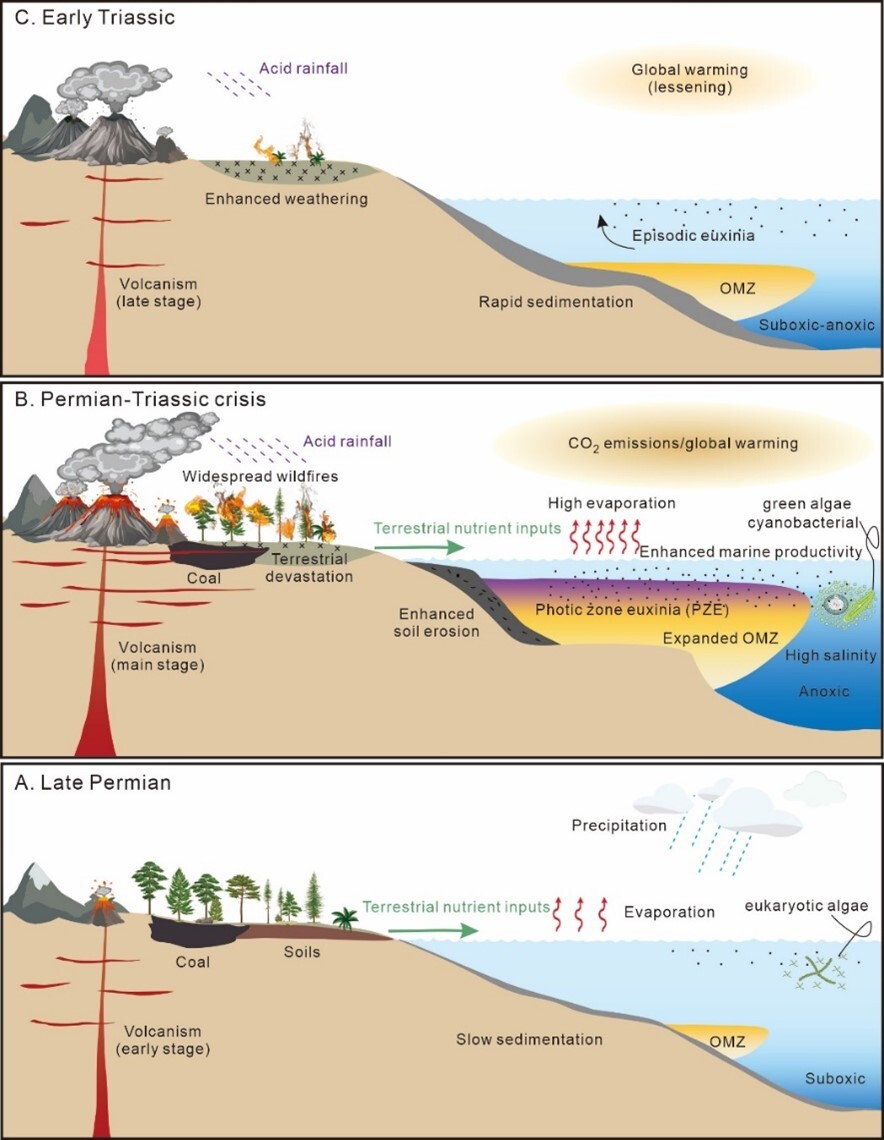
Conceptual models of oceanic anoxia and ecological disturbance in terrestrial–marine systems from the late Permian to Early Triassic. (Image by NIGPAS)
<関連情報>
- https://english.cas.cn/newsroom/research_news/earth/202512/t20251201_1134315.shtml
- https://www.sciencedirect.com/science/article/abs/pii/S0031018225007175
イラン北西部におけるペルム紀-三畳紀移行期の生態学的撹乱と微生物群集の動態 Ecological disturbance and microbial community dynamics across the Permian–Triassic transition in Northwest Iran
Shenglin Jiao, Hua Zhang, Sakineh Arefifard, Yaofeng Cai, Mohammad Nabi Gorgij, Xinyue Liu, Wei Ni, Lukang Tang, Jian Cao, Shuzhong Shen
Palaeogeography, Palaeoclimatology, Palaeoecology Available online: 20 November 2025
DOI:https://doi.org/10.1016/j.palaeo.2025.113432
Highlights
- Lipid biomarkers from the late Permian to Early Triassic periods were analysed in the Zal section of Iran.
- Episodic marine anoxia and alterations in microbial community occurred during the P–T transition.
- Soil erosion and extensive wildfires increased during the P–T transition.
- The observed alterations in the microbial community and ecological disturbances are consistent between Iran and South China during the P–T transition.
Abstract
The Permian–Triassic (P–T) transition witnessed the most severe biocrisis in the Phanerozoic, yet microbial community dynamics across this interval remain poorly constrained in key regions of the Paleotethys. Here, we present high-resolution hydrocarbon biomarker records from the Zal section (NW Iran) to reconstruct ecological disturbances and microbial responses from the Lopingian to Early Triassic. Our results reveal: (1) Elevated 2α-methylhopane index suggests a microbial community shift from eukaryotic green/red algae to bacteria, with cyanobacterial blooms at the extinction interval; (2) Repeated episodes of bottom-water anoxia and water-column stratification, indicated by a high gammacerane index, alongside persistent euxinia as shown by low pristane/phytane ratios and a strong even-over-odd predominance in n-alkanes; and (3) Enhanced terrestrial inputs from wildfires, recorded by pyrogenic polycyclic aromatic hydrocarbons, and soil erosion, marked by elevated dibenzofuran and dibenzothiophene, implicating land-derived nutrients in marine eutrophication. Critically, biomarker anomalies coincide with negative δ13C excursions and mirror trends in South China, supporting the interpretation of synchronous ecological degradation across the Paleotethys. These findings underscore volcanism-driven terrestrial collapse and expanded marine anoxia as pivotal amplifiers of the P–T biocrisis.

