2025-12-01 カリフォルニア大学サンタバーバラ校(UCSB)
<関連情報>
- https://news.ucsb.edu/2025/022239/new-ucsb-research-shows-p-computers-can-solve-spin-glass-problems-faster-quantum
- https://www.nature.com/articles/s41467-025-64235-y
- https://www.nature.com/articles/s41928-025-01439-6
確率的コンピュータを用いたハードな組み合わせ最適化における量子優位性の限界を押し広げる Pushing the boundary of quantum advantage in hard combinatorial optimization with probabilistic computers
Shuvro Chowdhury,Navid Anjum Aadit,Andrea Grimaldi,Eleonora Raimondo,Atharva Raut,P. Aaron Lott,Johan H. Mentink,Marek M. Rams,Federico Ricci-Tersenghi,Massimo Chiappini,Luke S. Theogarajan,Tathagata Srimani,Giovanni Finocchio,Masoud Mohseni & Kerem Y. Camsari
Nature Communications Published:16 October 2025
DOI:https://doi.org/10.1038/s41467-025-64235-y
Abstract
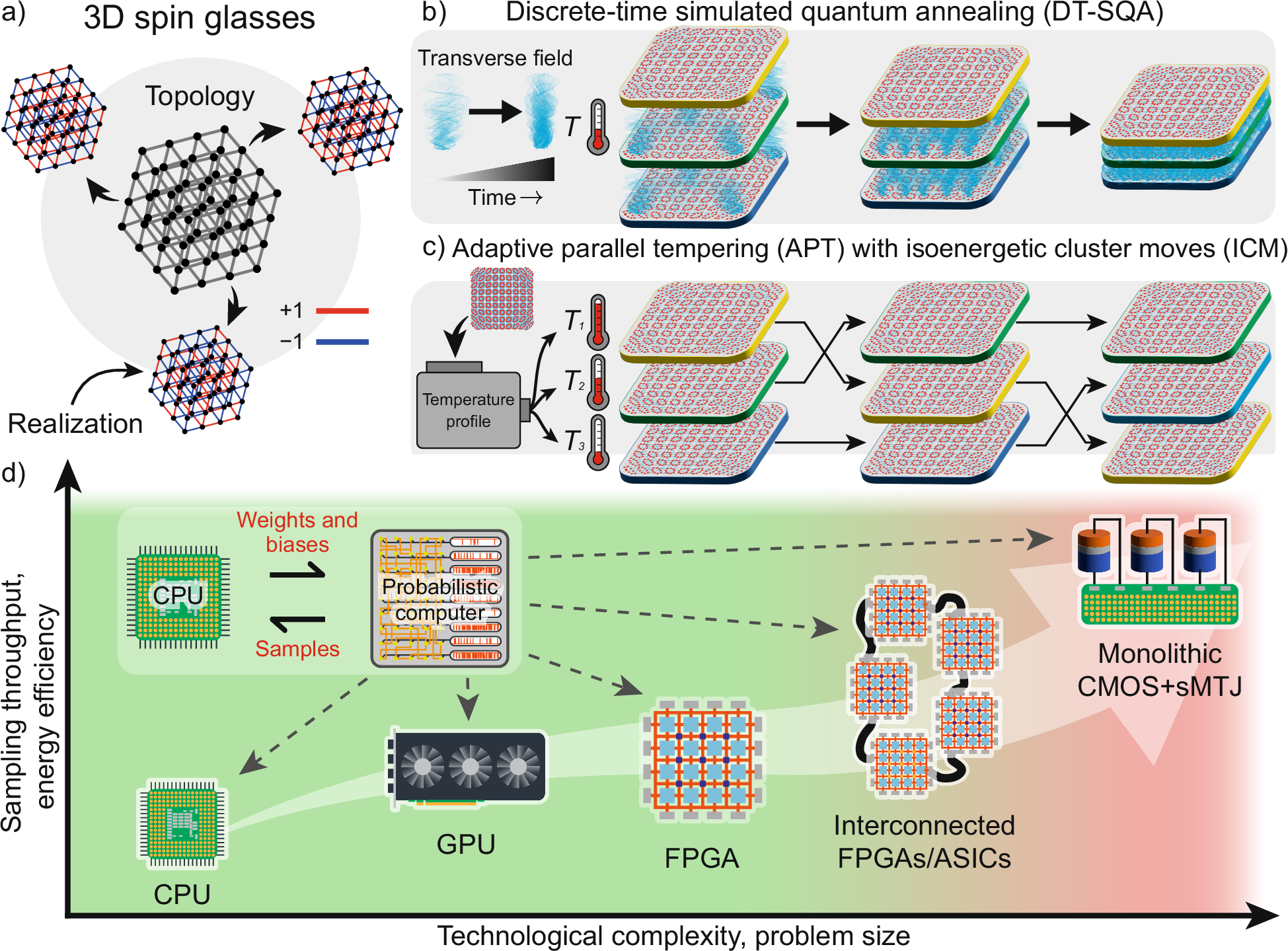
Recent demonstrations on specialized benchmarks have reignited excitement for quantum computers, yet their advantage for real-world problems remains an open question. Here, we show that probabilistic computers, co-designed with hardware to implement Monte Carlo algorithms, provide a scalable classical pathway for solving hard optimization problems. We focus on two algorithms applied to three-dimensional spin glasses: discrete-time simulated quantum annealing and adaptive parallel tempering. We benchmark these methods against a leading quantum annealer. For simulated quantum annealing, increasing replicas improves residual energy scaling, consistent with extreme value theory. Adaptive parallel tempering, supported by non-local isoenergetic cluster moves, scales more favorably and outperforms simulated quantum annealing. Field Programmable Gate Arrays or specialized chips can implement these algorithms in modern hardware, leveraging massive parallelism to accelerate them while improving energy efficiency. Our results establish a rigorous classical baseline for assessing practical quantum advantage and present probabilistic computers as a scalable platform for real-world optimization challenges.
電圧制御磁気トンネル接合をエントロピー源として利用する集積回路ベースの確率的コンピュータ An integrated-circuit-based probabilistic computer that uses voltage-controlled magnetic tunnel junctions as its entropy source
Christian Duffee,Jordan Athas,Yixin Shao,Noraica Davila Melendez,Eleonora Raimondo,Jordan A. Katine,Kerem Y. Camsari,Giovanni Finocchio & Pedram Khalili Amiri
Nature Electronics Published:13 August 2025
DOI:https://doi.org/10.1038/s41928-025-01439-6
Abstract
Probabilistic Ising machines could be used to solve computationally hard problems more efficiently than deterministic algorithms on von Neumann computers. Stochastic magnetic tunnel junctions are potential entropy sources for such Ising machines. However, scaling up stochastic magnetic tunnel junction probabilistic Ising machines requires the fine control of a small magnetic energy barrier and duplication of area-intensive digital-to-analogue converter elements across large numbers of devices. The non-spintronic components of these machines are also typically created using general-purpose processors or field-programmable gate arrays. Here we report a probabilistic computer that is based on an application-specific integrated circuit fabricated using 130-nm foundry complementary metal–oxide–semiconductor technology and uses voltage-controlled magnetic tunnel junctions as its entropy source. With the system, we implement integer factorization as a representative hard optimization problem using probabilistic Ising-machine-based invertible logic gates created with 1,143 probabilistic bits. The application-specific integrated circuit uses stochastic bit sequences read from an adjacent voltage-controlled magnetic tunnel junction chip. The magnetic tunnel junctions are thermally stable in the absence of a voltage and synchronously generate random bits without the use of digital-to-analogue converter elements using the voltage-controlled magnetic anisotropy effect.