2025-11-04 イリノイ大学アーバナ・シャンペーン校
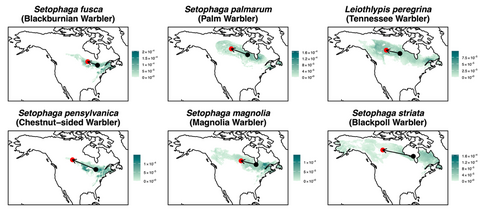
Maps showing the origins in the breeding ranges for all six wood warbler species. Red dots indicate the center of the estimated origin area for the vagrant birds compared to the population center of the breeding range, indicated with a black dot. In all species, vagrants originated from areas much further west than the main population center.
<関連情報>
- https://aces.illinois.edu/news/lost-or-leading-way-rare-birds-may-signal-shifting-migration-routes
- https://academic.oup.com/auk/advance-article-abstract/doi/10.1093/ornithology/ukaf057/8307131
カリフォルニアに迷鳥として生息する6種の鳴鳥の共通の起源 Shared origins of six songbird species occurring as vagrants in California
Eliana R Heiser, Andrew Farnsworth, James Tietz, Marshall J Iliff, Benjamin M Van Doren
Ornithology Published:31 October 2025
DOI:https://doi.org/10.1093/ornithology/ukaf057
Abstract
Avian vagrancy may serve an important function in the evolution of migration routes and avian responses to global change; however, few data are available to test hypotheses about the mechanisms of vagrancy due to the inherent rarity of the phenomenon. We investigated the breeding origins of 6 species of wood-warblers (Parulidae) occurring as vagrants in California, USA, during fall migration. We used stable hydrogen isotope analysis to assign breeding origins to 155 vagrant individuals and designed simulations to test whether their origin locations could be explained by the relative abundance of their species across its breeding range. We found that nearly all vagrant individuals we sampled of all 6 species were most likely to originate from the western parts of their breeding ranges, which are not the areas of greatest breeding abundance. Five of our 6 study species showed geographic overlap in their probable origin locations. This consistency in likely origin locations across species suggests that common factors underlie vagrancy in wood-warblers in California. Determining these factors has important implications for the evolution of various animal movement behaviors, especially migration. We suggest that future studies of the mechanisms driving songbird vagrancy to California consider the shared origins we describe when formulating hypotheses, and we recommend that researchers test for similar patterns in other vagrant systems.