2025-11-04 中国科学院(CAS)
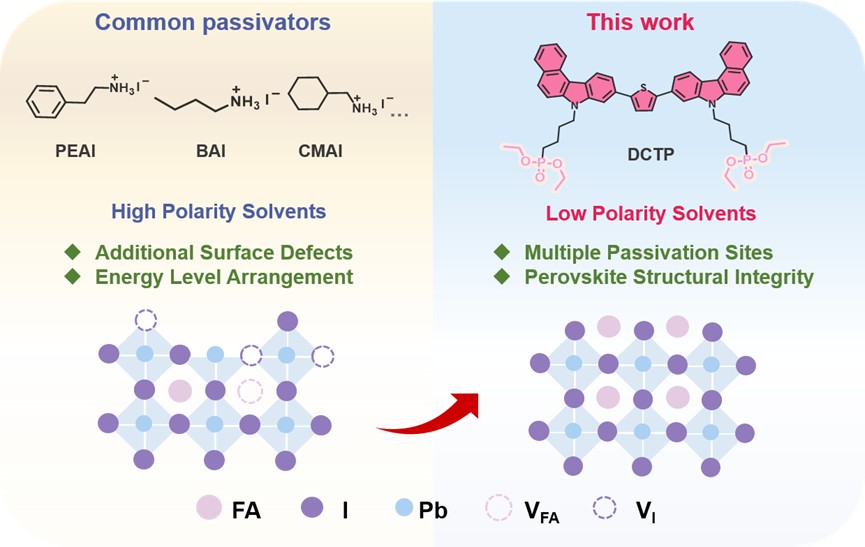
DCTP’s solubility in low-polarity solvents without surface damage versus conventional passivators. (Image by NIMTE)
<関連情報>
- https://english.cas.cn/newsroom/research_news/tech/202511/t20251105_1096032.shtml
- https://advanced.onlinelibrary.wiley.com/doi/10.1002/adma.202513151
ビスホスホネート埋め込みπ共役不動態化剤が低極性溶媒処理による効率的かつ安定したnipペロブスカイト太陽電池を実現 Bisphosphonate-Embedded a π-Conjugated Passivator Enable Efficient and Stable n-i-p Perovskite Solar Cells with Low-Polarity Solvent Processing
Xiaochun Liao, Yueli Liu, Xinyue Cao, Jie Wu, Tongqiang Liu, Pengfei Ding, Jialei Liu, Qiaoling Zuo, He Sun, Bo Qu, Lixin Xiao, Daobin Yang, Ziyi Ge
Advanced Materials Published: 04 October 2025
DOI:https://doi.org/10.1002/adma.202513151
Abstract
Interface passivators play a critical role in improving the efficiency of perovskite solar cells (PSCs). However, the conventional passivators often require processing in high-polarity solvents that can cause additional surface defects on the perovskite film, thereby reducing the efficiency and stability of n-i-p PSCs. Herein, a bisphosphate molecule (named DCTP) is designed and synthesized to simultaneously address solvent compatibility, defect passivation, and hole extraction. DCTP has good solubility in low-polarity solvents such as toluene, chlorobenzene, and chloroform without damaging the perovskite surface. The chlorobenzene-processed DCTP interlayer can sufficiently passivate the defects on the perovskite surface and improve the energy level arrangement at the perovskite/hole transporting layer interface. Meanwhile, the DCTP layer effectively inhibits interlayer diffusion of formamidine (FA+), iodide (I−), and lithium (Li+) and ions under thermal stress. As a result, the DCTP-controlled device produces a champion power conversion efficiency (PCE) of 26.07% with excellent reproducibility, compared to 24.28% for the reference device. More importantly, the operational stability of the device is significantly improved. The DCTP-treated device retains 90.1% of its initial PCE after 900 h of maximum power point tracking (MPPT) at 65 °C under the ISOS-L-2I protocol.