2025-10-27 ペンシルベニア州立大学(PennState)
<関連情報>
- https://www.psu.edu/news/research/story/ai-powered-model-predicts-floods-improves-water-management-worldwide
- https://www.nature.com/articles/s41467-025-64367-1
物理学を組み込んだ学習によって明らかになった、世界各地の水文学的応答パターンと傾向 Distinct hydrologic response patterns and trends worldwide revealed by physics-embedded learning
Haoyu Ji,Yalan Song,Tadd Bindas,Chaopeng Shen,Yuan Yang,Ming Pan,Jiangtao Liu,Farshid Rahmani,Ather Abbas,Hylke Beck,Kathryn Lawson & Yoshihide Wada
Nature Communications Published:15 October 2025
DOI:https://doi.org/10.1038/s41467-025-64367-1
Abstract
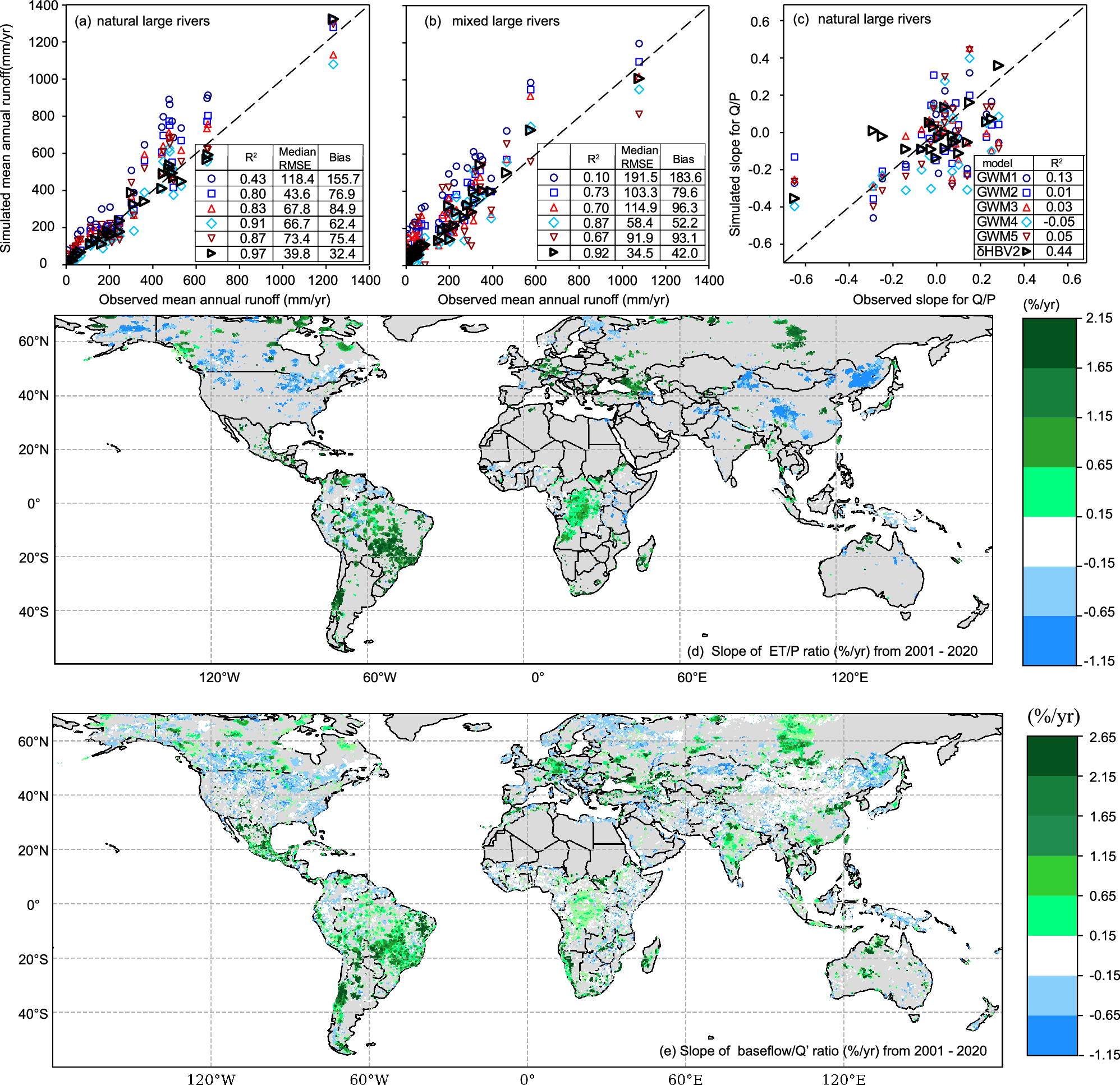
To track rapid changes within our water sector, Global Water Models (GWMs) need to realistically represent hydrologic systems’ response patterns — such as the baseflow fraction of streamflow — but are hindered by their limited ability to learn from data. Here we introduce a high-resolution, physics-embedded, big-data-trained model to reliably capture characteristic hydrologic response patterns (signatures) and their shifts. By realistically representing the long-term water balance, the model revealed widespread shifts — in some cases, more than 20% over 20 years — in fundamental green-blue-water partitioning and baseflow ratios worldwide. Shifts in these previously-assumed-static response patterns contributed to increasing flood risks in northern mid-latitudes, heightening water supply stresses in southern subtropical regions, and declining freshwater inputs to many European estuaries, all with ecological implications. With substantially more accurate simulations at monthly and daily scales than current operational systems, this next-generation model resolves large, nonlinear, seasonal runoff responses to rainfall (elasticity) and streamflow flashiness in semi-arid and arid regions. Our results highlight regions with management challenges due to large water supply variability and high climate sensitivity, and demonstrate an advanced tool to forecast seasonal water availability. This capability enables global-scale models to deliver reliable and locally-relevant insights for water management.