2025-10-24 広島大学
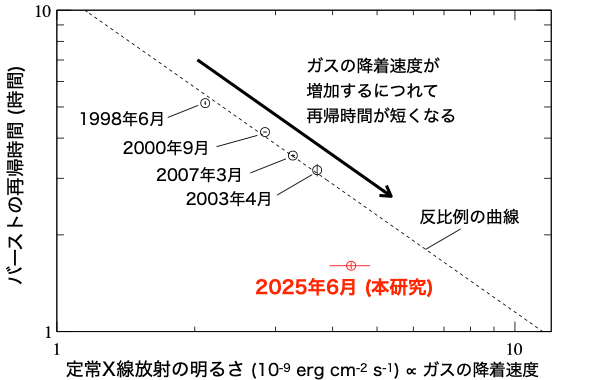
図1: NinjaSat と他の衛星が観測した GS 1826−238の定常X線放射の明るさとバースト再帰時間の関係。黒丸で示した過去の観測では、X線で明るくなる(ガスの降着速度が速くなる)につれてバーストの再帰時間が短くなり、反比例の関係(点線)に概ね従う。一方で、今回の観測結果(赤丸)はこの関係から下方にずれていることがわかる。
<関連情報>
- https://www.hiroshima-u.ac.jp/news/93553
- https://www.hiroshima-u.ac.jp/system/files/273205/NinjaSat.pdf
- https://iopscience.iop.org/article/10.3847/2041-8213/ae0e75
クロックドバースターの復活:GS 1826−238における例外的に短い再発時間 Return of the Clocked Burster: Exceptionally Short Recurrence Time in GS 1826−238
Tomoshi Takeda, Toru Tamagawa, Teruaki Enoto, Wataru Iwakiri, Akira Dohi, Tatehiro Mihara, Hiromitsu Takahashi, Chin-Ping Hu, Amira Aoyama, Naoyuki Ota,…
The Astrophysical Journal Letters Published: 2025 October 24
DOI:10.3847/2041-8213/ae0e75
Abstract
We report the discovery of an exceptionally short burst recurrence time in the well-known clocked burster GS 1826−238, observed with the CubeSat X-ray observatory NinjaSat. In 2025 May, GS 1826−238 underwent a soft-to-hard state transition for the first time in 10 yr. On June 23, NinjaSat began monitoring GS 1826−238 in the hard state and continued until it returned to a steady soft state. During this period, we detected 19 X-ray bursts: 14 during the hard state, 4 in the transitional state, and 1 in the soft state. In the hard state, we identified a new clocked bursting epoch, during which the burst recurrence time remained highly stable and unprecedentedly short among the clocked bursting phases of GS 1826−238, with trec = 1.603 ± 0.040 hr (1σ error). Previous observations showed that the burst recurrence time in GS 1826−238 decreased with increasing mass accretion rate, reached its minimum value of trec ∼ 3 hr, and then increased again. The observed 1.6 hr recurrence time is therefore exceptionally short, indicating anomalous ignition conditions. We propose that this phenomenon reflects fuel accumulation over a smaller fraction of the neutron star surface, resulting in a higher local accretion rate compared to earlier epochs. This scenario naturally accounts for the exceptionally short recurrence time, together with the observed reductions during bursts in blackbody normalization (proportional to the emitting area) and fluence. We also discuss possible contributions from residual heat in the neutron star crust or the presence of an additional soft spectral component.