2025-10-22 中国科学院 (CAS)
<関連情報>
- https://english.cas.cn/newsroom/research_news/earth/202510/t20251022_1089988.shtml
- https://www.nature.com/articles/s41467-025-65000-x
地上風速の変化に対する地球規模の植生生産性の顕著な感受性 Significant sensitivity of global vegetation productivity to terrestrial surface wind speed changes
Haohao Wu,Congsheng Fu,Lingling Zhang,Zelalem A. Mekonnen,Qing Zhu,Kailiang Yu,Philippe Ciais,Jianyao Chen,Dagang Wang,Huawu Wu & Guishan Yang
Nature Communications Published:21 October 2025
DOI:https://doi.org/10.1038/s41467-025-65000-x
Abstract
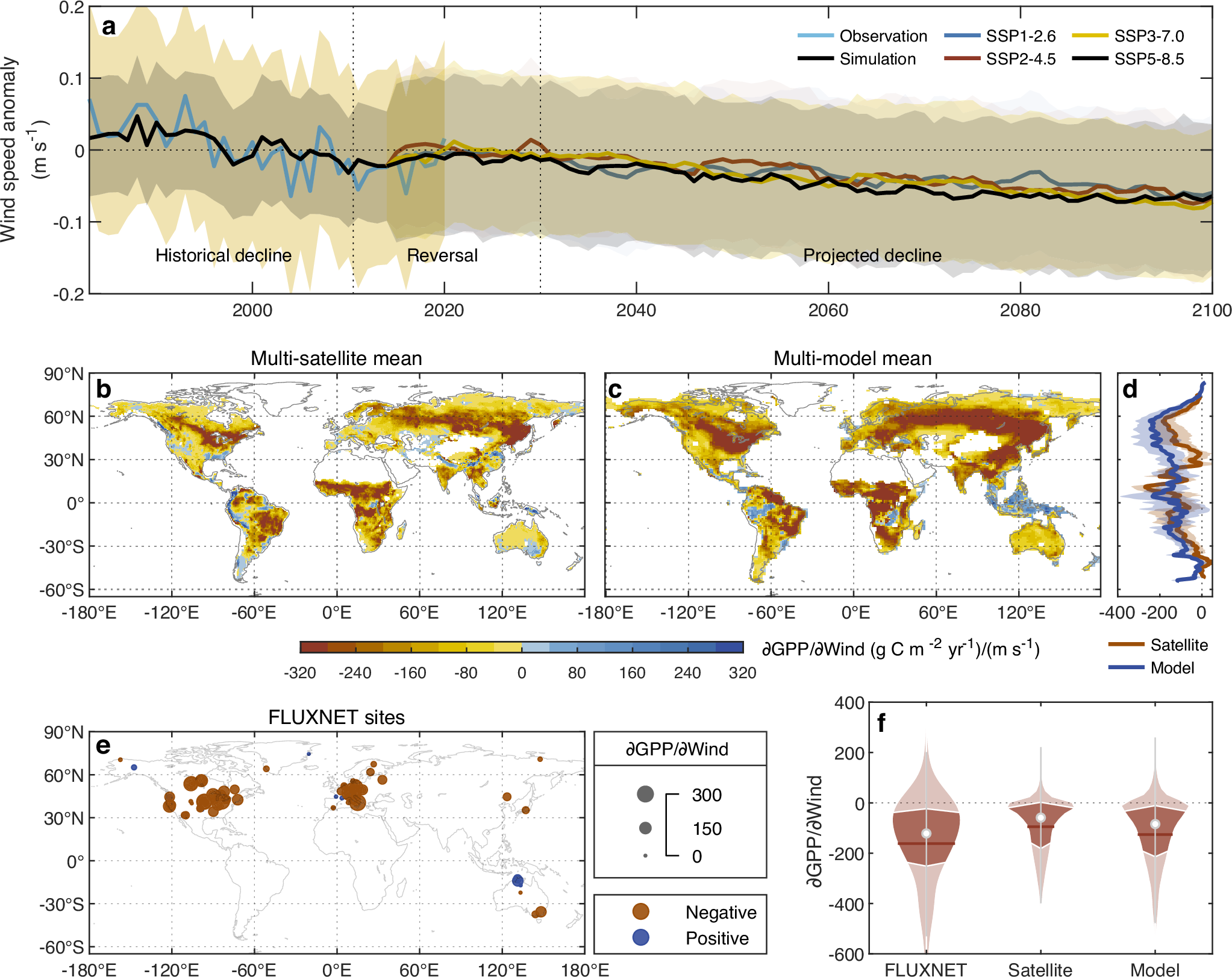
Decadal changes in terrestrial surface wind speed since the 1960s have been extensively documented, while the mechanism and the extent of their impacts on terrestrial ecosystem productivity remain unclear. Here, we systematically explore the impacts of wind speed changes on terrestrial gross primary production (GPP) using satellite-derived data, reanalysis datasets, flux tower observations, CMIP6 models, and exploratory simulation experiments. Our results show a negative sensitivity of terrestrial GPP to wind speed change, ranging from −156.67 to −65.82 g C m−2 yr−1 (m s−1)−1, across different data sources from 1983 to 2100. This is mainly attributed to the impacts of wind speed decline on stomatal conductance by reducing atmospheric dryness and soil drying. We find that during 1983 – 2010, wind speed decline is the most important factor, after rising atmospheric CO2 concentrations, in its contribution to the increasing trend in GPP (6.0% –7.8%). With further declines in wind speed, this contribution to GPP is projected to rank between second and third during 2031 – 2100. Among seven plant functional types, grasslands contribute most to the wind-induced changes in the GPP trend under current and future climates. These findings highlight the substantial effects of wind speed on centennial-scale global carbon dynamics.