
2025-10-14 物質・材料研究機構,東京理科大学,神戸大学,科学技術振興機構
Web要約 の発言:
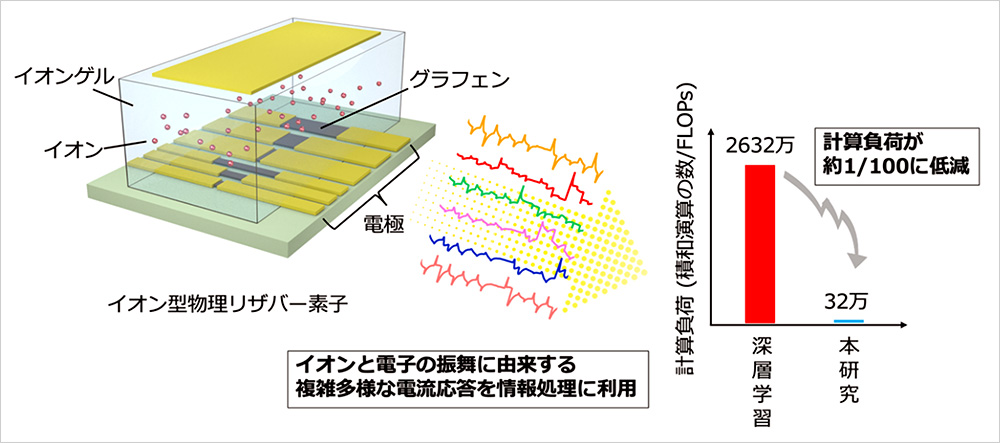
図: 本研究で開発したイオン型物理リザバー(左)と、典型的ベンチマーク試験で達成した計算負荷の低減(右)。
<関連情報>
- https://www.nims.go.jp/press/2025/10/202510140.html
- https://www.nims.go.jp/press/2025/10/eqbnjl0000004how-att/202510140.pdf
- https://pubs.acs.org/doi/10.1021/acsnano.5c06174
イオンゲーティングリザーバーの超広帯域応答により計算負荷を2桁削減 Two Orders of Magnitude Reduction in Computational Load Achieved by Ultrawideband Responses of an Ion-Gating Reservoir
Daiki Nishioka,Hina Kitano,Wataru Namiki,Satofumi Souma,Kazuya Terabe,and Takashi Tsuchiya
ACS Nano Published: October 13, 2025
DOI:https://doi.org/10.1021/acsnano.5c06174
Abstract
The rising energy demands of conventional AI systems underscore the need for efficient computing technologies, such as brain-inspired computing. Physical reservoir computing (PRC), leveraging the nonlinear dynamics of physical systems for information processing, has emerged as a promising approach for neuromorphic computing. However, current PRC systems are constrained by narrow responsive time scales and limited performance. To address these challenges, an ion-gel/graphene electric double layer (EDL) transistor-based ion-gating reservoir (IGR) was developed. This IGR achieves a highly tunable and ultrawide time-scale response through the coexistence of fast EDL dynamics at the ion-gel/graphene interface and slower molecular adsorption dynamics on the graphene surface. Consequently, the system demonstrates an exceptionally broad responsive range, from 1 MHz to 20 Hz, while maintaining a high information processing capacity and adaptability across multiple time scales. The IGR achieved deep learning (DL)-level accuracy in chaotic time series prediction tasks while reducing computational resource requirements to 1/100 of those needed by DL. Principal component analysis reveals the IGR’s superior performance stems from its high-dimensionality, driven by the ultrawideband responses of the EDL along with the ambipolar behavior of graphene. The proposed IGR represents a significant step forward in providing low-power, high-performance computing solutions, particularly for resource-constrained edge environments.
