2025-10-01 マサチューセッツ工科大学(MIT)
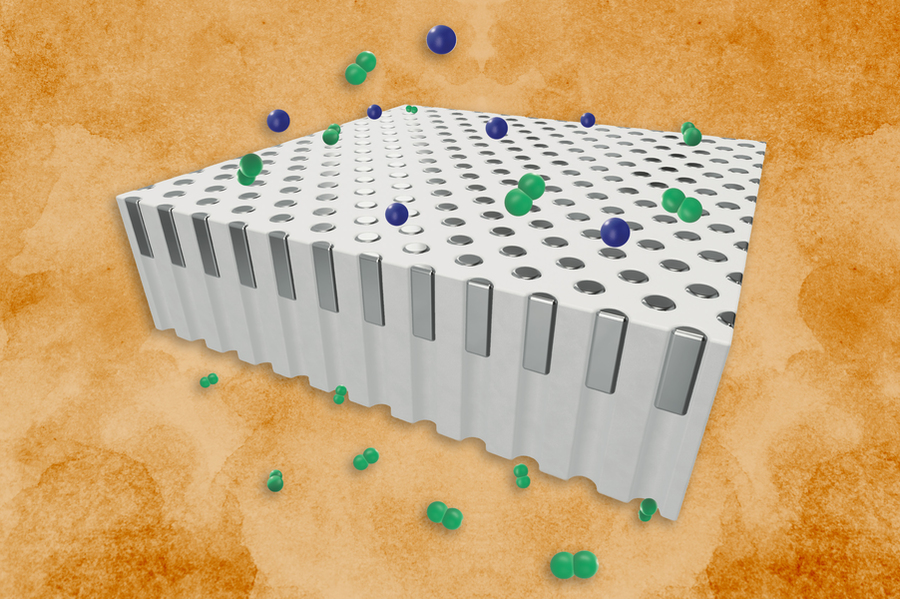
Schematic illustration of the membrane showing selective permeation of hydrogen (green) from a mixture of hydrogen and helium (blue) gases. Credit: Lohyun Kim
<関連情報>
- https://news.mit.edu/2025/palladium-filters-could-enable-cheaper-more-efficient-generation-hydrogen-fuel-1001
- https://advanced.onlinelibrary.wiley.com/doi/10.1002/adfm.202516184
高温に耐えられるナノ構造水素選択性パラジウム「プラグ」膜 Nanostructured Hydrogen-Selective Palladium “Plug” Membranes Capable of Withstanding High Temperatures
Lohyun Kim, Aaron H. Persad, Chun Man Chow, Randall Field, Rohit Karnik
Advanced Functional Materials Published: 01 October 2025
DOI:https://doi.org/10.1002/adfm.202516184
Abstract
The thermal instability of conventional palladium (Pd) membranes at high temperatures due to solid-state dewetting or interdiffusion-induced alloying limits hydrogen (H2) separations in applications such as small-scale steam methane reforming, ammonia cracking, and nuclear fusion. Here, to mitigate these key degradation mechanisms in Pd membranes, a nanostructured Pd “plug” composite membrane is developed comprising discretized, thermally stable plug structures embedded in nanopores of a silicon-based membrane. The membrane is fabricated via directional electroless plating, achieving practically 100% filling of the nanopores with Pd plugs. Gas permeation tests compared well with transport model predictions and demonstrated H2 permeance of ≈10−7 mol m−2·s−1·Pa−1 at 800 K, with no detectable helium or nitrogen leakage, indicating high H2 selectivity. Structural analysis revealed some morphological transitions of the Pd plugs at high temperatures, but without degrading the performance. The membrane remained leakage-free after 114 h of operation at 800 K and after 100 h at 1000 K, demonstrating exceptional thermal robustness over conventional Pd membranes. These findings establish the Pd plug membrane as a strong candidate for high-temperature H2 separations and illustrate the design of membranes with thermally stable metal nanostructures as a general strategy to realize high-temperature H2 separations.