2025-09-12 農研機構,愛媛大学,bitBiome株式会社
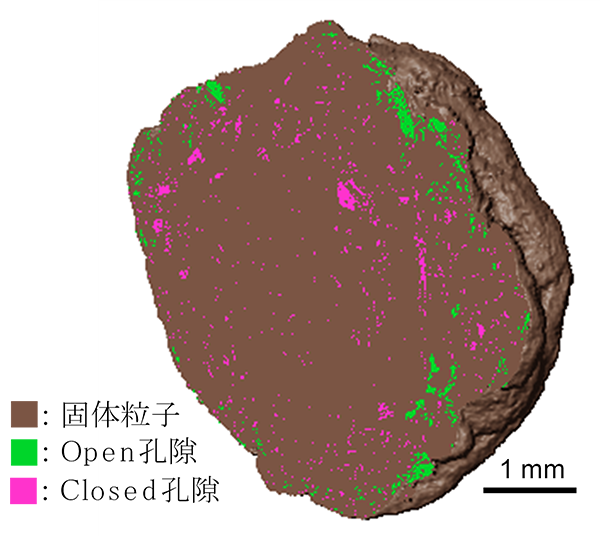
図. 土壌団粒中の孔隙(黄色土)
ミクロスケール観察によって調べました(備考2. 光延・和穎(2025)より転載)。Open孔隙は団粒外の大気と繋がった孔隙、Closed孔隙は繋がっていない孔隙です。
<関連情報>
- https://www.naro.go.jp/publicity_report/press/laboratory/niaes/171101.html
- https://www.frontiersin.org/journals/microbiology/articles/10.3389/fmicb.2025.1557188/full
単一土壌団塊の単一細胞ゲノミクス:窒素代謝に焦点を当てた方法論的評価と潜在的な示唆
Single-cell genomics of single soil aggregates: methodological assessment and potential implications with a focus on nitrogen metabolism
Emi Matsumura,Hiromi Kato,Shintaro Hara,Tsubasa Ohbayashi,Koji Ito,Ryo Shingubara,Tomoya Kawakami,Satoshi Mitsunobu,Tatsuya Saeki,Soichiro Tsuda,Kiwamu Minamisawa,Rota Wagai
Frontiers in Microbiology Published:07 April 2025
DOI:https://doi.org/10.3389/fmicb.2025.1557188
Soil particles in plant rooting zones are largely clustered to form porous structural units called aggregates where highly diverse microorganisms inhabit and drive biogeochemical cycling. The complete extraction of microbial cells and DNA from soil is a substantial task as certain microorganisms exhibit strong adhesion to soil surfaces and/or inhabit deep within aggregates. However, the degree of aggregate dispersion and the efficacy of extraction have rarely been examined, and thus, adequate cell extraction methods from soil remain unclear. We aimed to develop an optimal method of cell extraction for single-cell genomics (SCG) analysis of single soil aggregates by focusing on water-stable macroaggregates (diameter: 5.6–8.2 mm) from the topsoil of cultivated Acrisol. We postulated that the extraction of microorganisms with distinct taxonomy and functions could be achieved depending on the degree of soil aggregate dispersion. To test this idea, we used six individual aggregates and performed both SCG sequencing and amplicon analysis. While both bead-vortexing and sonication dispersion techniques improved the extractability of bacterial cells compared to previous ones, the sonication technique led to more efficient dispersion and yielded a higher number and more diverse microorganisms than the bead technique. Furthermore, the analyses of nitrogen cycling and exopolysaccharides-related genes suggested that the sonication-assisted extraction led to the greater recovery of microorganisms strongly attached to soil particles and/or inhabited the aggregate subunits that were more physically stable (e.g., aggregate core). Further SCG analysis revealed that all six aggregates held intact microorganisms holding the genes (potentials) to convert nitrate into all possible nitrogen forms while some low-abundance genes showed inter-aggregate heterogeneity. Overall, all six aggregates studied showed similarities in pore characteristics, phylum-level composition, and microbial functional redundancy. Together, these results suggest that water-stable macroaggregates may act as a functional unit in soil and show potential as a useful experimental unit in soil microbial ecology. Our study also suggests that conventional methods employed for the extraction of cells and DNA may not be optimal. The findings of this study emphasize the necessity of advancing extraction methodologies to facilitate a more comprehensive understanding of microbial diversity and function in soil environments.