2025-09-04 中国科学院(CAS)
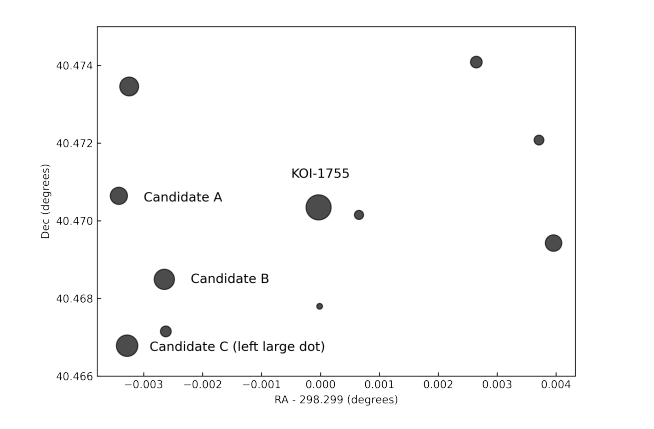
Candidate objects near KOI-1755 responsible for the transit-like signal, with Candidate B ultimately confirmed as the true source. (Image by XAO)
<関連情報>
- https://english.cas.cn/newsroom/research_news/phys/202509/t20250904_1053933.shtml
- https://iopscience.iop.org/article/10.3847/1538-3881/ade718
KOI-1755のトランジット信号は背景の食連星に由来する―ケプラー観測対象ピクセルファイルデータから微光背景星の光度曲線を抽出 The Transit Signal of KOI-1755 Originates from a Background Eclipsing Binary Star—Extracting the Light Curve of a Faint Background Star from Kepler Target Pixel File Data
Haozhi Wang, Ali Esamdin, Chenglong Lv, Lixian Shen, Jin-zhong Liu, Abdusamatjan Iskandar, Umut Mahmut, Rivkat Karimov, and Shuhrat A. Ehgamberdiev
The Astronomical Journal Published: 2025 July 22
DOI:10.3847/1538-3881/ade718
Abstract
KOI-1755 (KIC 5302006) was initially identified by the Kepler mission as a candidate exoplanet host but subsequently classified as a false positive due to suspected background contamination. The target star itself exhibits intrinsic stellar pulsations, accompanied by transit-like dimming events, complicating a straightforward identification of the signal source. In this study, we carried out a detailed pixel-level reanalysis of KOI-1755 using the Kepler Target Pixel Files (TPFs) to clarify the origin of these transit-like signals. Through careful pixel-level flux modeling, centroid shift measurements, and cross-matching with the Gaia DR3 catalog, we conclusively determined that the dimming signals originate from a faint background eclipsing binary (EB), rather than KOI-1755 itself. We then developed a specialized photometric method to effectively remove contamination from nearby stars, allowing us to reliably extract the EB’s uncontaminated light curve directly from the TPFs data. Analysis of this extracted light curve confirmed the contaminating source to be an EB system composed of two dwarf stars with a clear eclipse period of approximately 6.14 days. Our study provides a concrete example of how background EBs can mimic planetary transit signals, highlighting the importance of detailed pixel-level analyses for correctly identifying astrophysical false positives. Furthermore, our method demonstrates significant potential for uncovering previously hidden variable-star information within archival Kepler data, thus emphasizing the continuing scientific value of mining and reanalyzing existing data sets.