

2025-08-26 アルゴンヌ国立研究所(ANL)
<関連情報>
- https://www.anl.gov/article/do-batteries-need-medicine
- https://www.nature.com/articles/s41467-025-57961-w
高性能5V LiNi₀.₅Mn₁.₅O₄正極を支える電解質添加剤のデータ駆動設計 Data-driven design of electrolyte additives supporting high-performance 5 V LiNi0.5Mn1.5O4 positive electrodes
Bingning Wang,Hieu A. Doan,Seoung-Bum Son,Daniel P. Abraham,Stephen E. Trask,Andrew Jansen,Kang Xu & Chen Liao
Nature Communications Published:10 April 2025
DOI:https://doi.org/10.1038/s41467-025-57961-w
Abstract
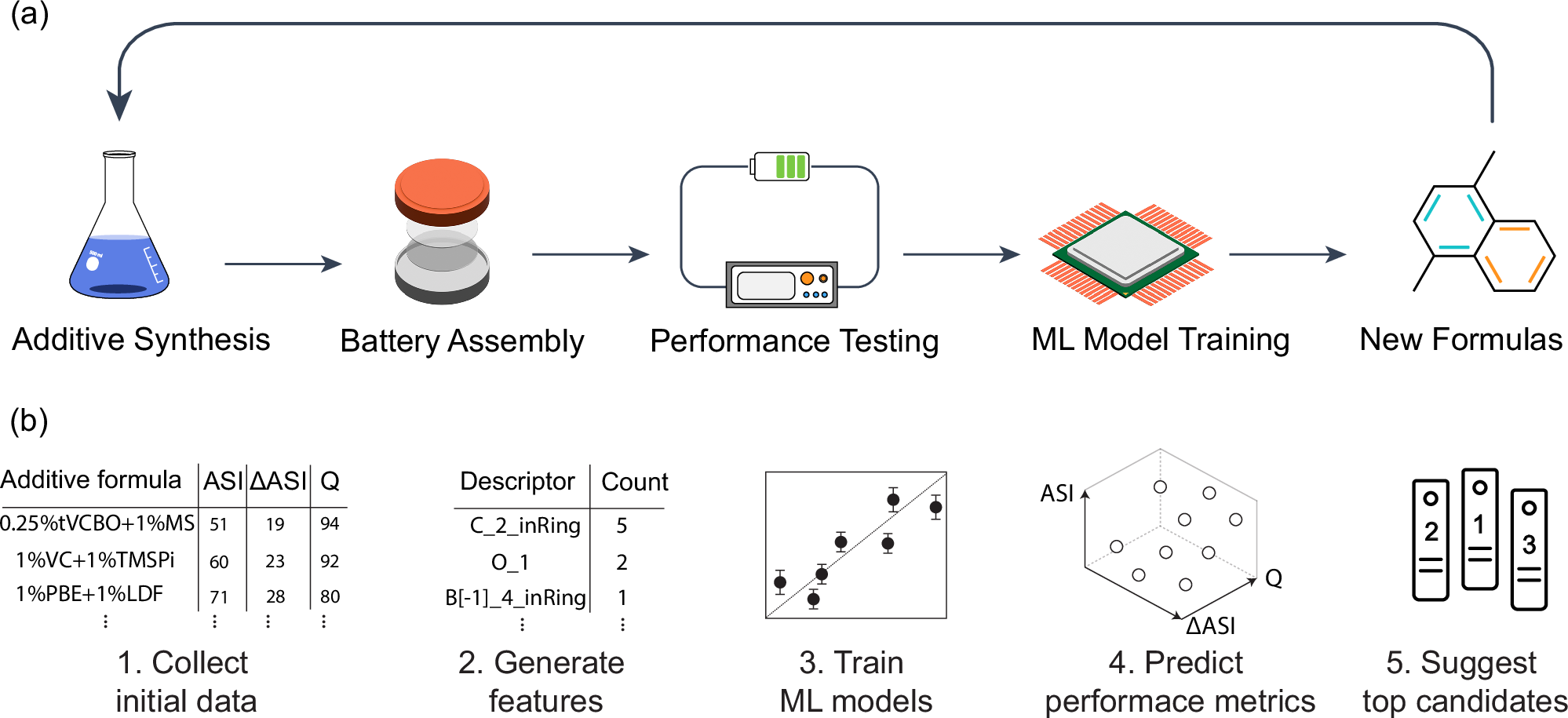
LiNi0.5Mn1.5O4 (LNMO) is a high-capacity spinel-structured material with an average lithiation/de-lithiation potential at ca. 4.6–4.7 V vs Li+/Li, far exceeding the stability limits of electrolytes. An efficient way to enable LNMO in lithium-ion batteries is to reformulate an electrolyte composition that stabilizes both graphitic (Gr) negative electrode with solid-electrolyte-interphase and LNMO with cathode-electrolyte-interphase. In this study, we select and test a diverse collection of 28 single and dual additives for the Gr||LNMO battery system. Subsequently, we train machine learning models on this dataset and employ the trained models to suggest 6 binary compositions out of 125, based on predicted final area-specific-impedance, impedance rise, and final specific-capacity. Such machine learning-generated new additives outperform the initial dataset. This finding not only underscores the efficacy of machine learning in identifying materials in a highly complicated application space but also showcases an accelerated material discovery workflow that directly integrates data-driven methods with battery testing experiments.

