2025-08-15 コペンハーゲン大学(UCPH)
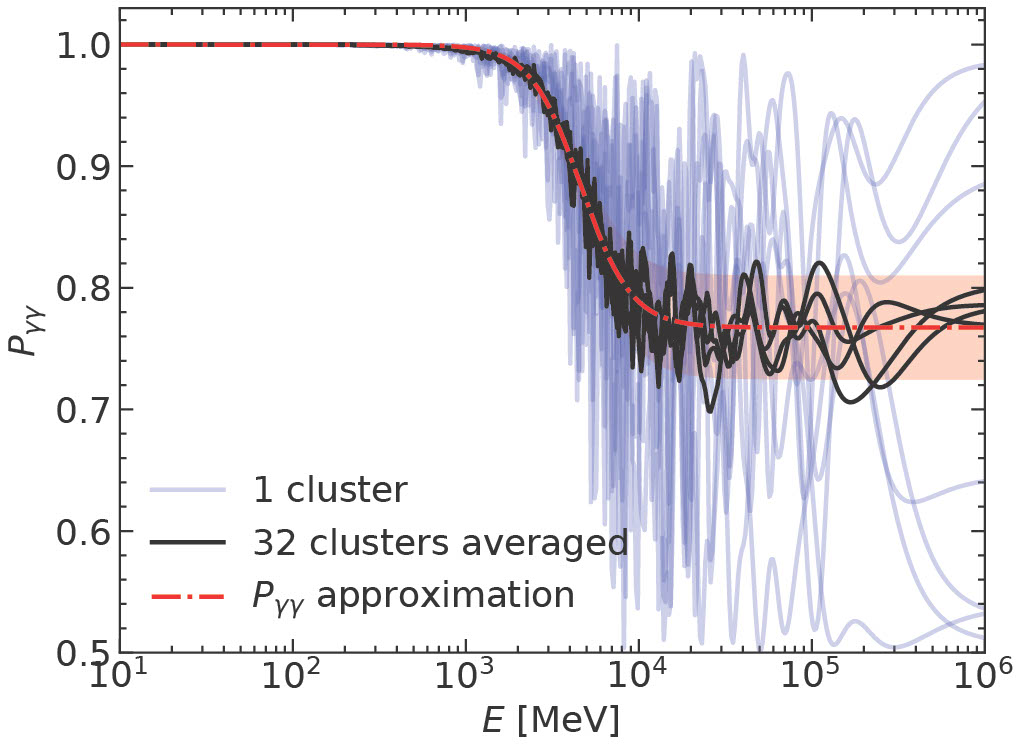
The step-like pattern revealed in the data observed by the researchers, potentially showing the conversion from gamma rays to axions. Illustration from the research paper.
<関連情報>
- https://news.ku.dk/all_news/2025/08/intergalactic-experiment-researchers-hunt-for-mysterious-dark-matter-particle-with-clever-new-trick/
- https://www.nature.com/articles/s41550-025-02621-8
銀河団を通じた活動銀河核から観測されるアクシオン類似粒子の制約 Constraints on axion-like particles from active galactic nuclei seen through galaxy clusters
Denys Malyshev,Lidiia Zadorozhna,Yuriy Bidasyuk,Andrea Santangelo & Oleg Ruchayskiy
Nature Astronomy Published:15 August 2025
DOI:https://doi.org/10.1038/s41550-025-02621-8
Abstract
Hypothetical axion-like particles (ALPs) are of interest because of their potential to act as dark matter or to reveal information about yet undiscovered fundamental constituents of matter. Such particles may be created when photons traverse regions of magnetic fields. The conversion probability depends on both the magnetic field parameters and the photon energy, leading to several spectral absorption features as light passes through magnetized regions. Traditionally, astrophysical searches have focused on detecting such features in individual objects. However, our limited understanding of the properties of cosmic magnetic fields has hindered progress. Here we introduce a new approach based on analysing the stacked (rather than individual) spectra of active galactic nuclei behind galaxy clusters, which are gigantic magnetic field reservoirs. Stacking efficiently averages over the uncertainties in magnetic fields, predicting a distinct step-like spectral signature of photon-to-ALP conversion. With this approach, we advance into previously inaccessible regions of the ALP parameter space for nano-electronvolt masses. Adopting this method using data from different telescopes and increasing the size of the stacked datasets will significantly improve existing bounds across a wide range of masses. The Cherenkov Telescope Array Observatory will enable this method to probe a broad region of parameter space where ALPs could serve as dark matter.