
2025-08-013 米国再生可能エネルギー研究所(NREL)
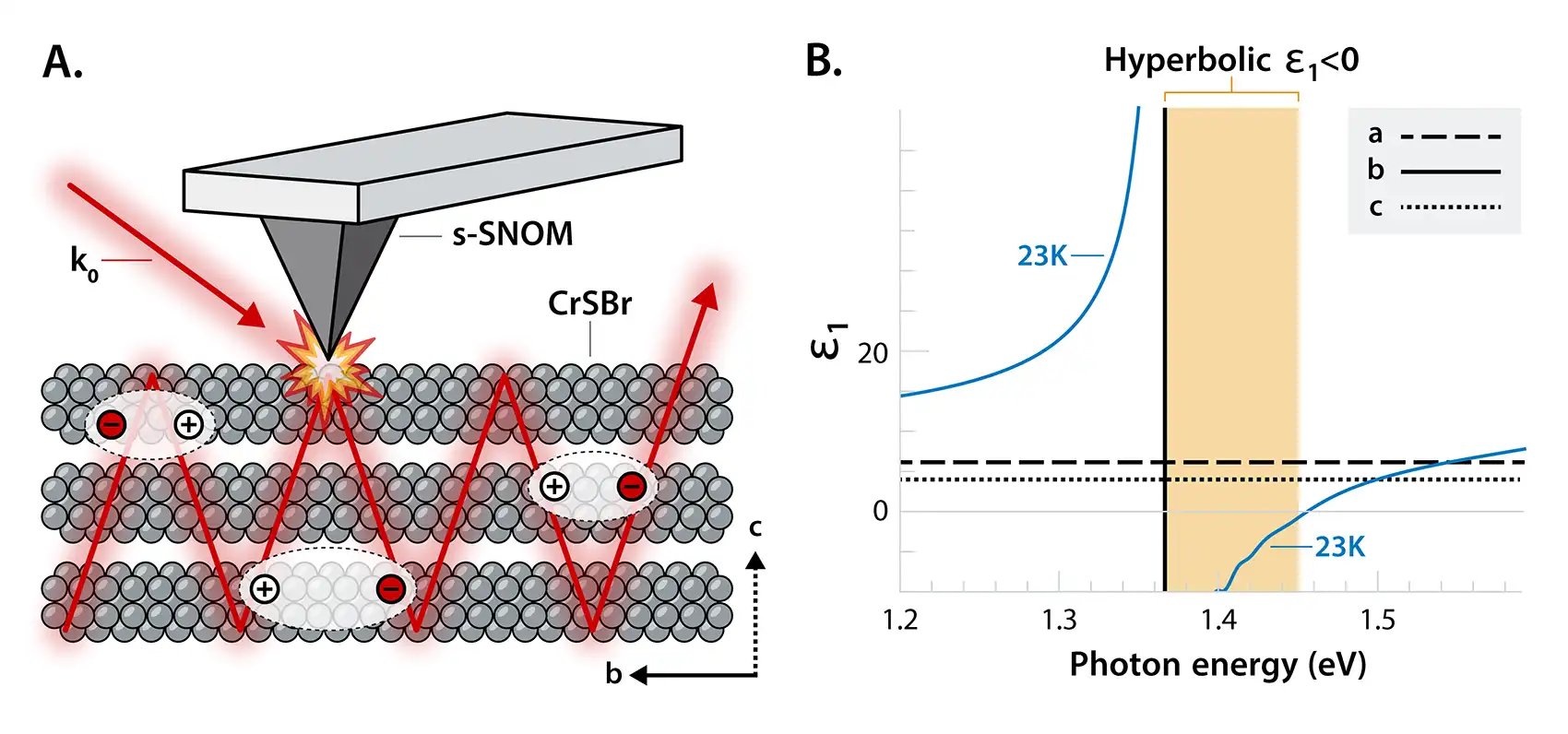 Hyperbolic region in chromium sulfur bromide (CrSBr): a) This schematic shows the metallized tapping tip of a scattering-type scanning near-field optical microscope illuminated by free-space light with momentum k0. The tip activates waveguide modes that couple to excitons in CrSBr. b) Dielectric functions show that in the orange band (hyperbolic region) they have opposite signs along the a and b axis.
<関連情報>
- https://www.nrel.gov/news/detail/2025/researchers-observe-evidence-of-hyperbolic-exciton-polaritons
- https://www.nature.com/articles/s41467-023-44100-6
ファンデルワールス磁石における双曲線型エキソンポラリトン Hyperbolic exciton polaritons in a van der Waals magnet
Francesco L. Ruta,Shuai Zhang,Yinming Shao,Samuel L. Moore,Swagata Acharya,Zhiyuan Sun,Siyuan Qiu,Johannes Geurs,Brian S. Y. Kim,Matthew Fu,Daniel G. Chica,Dimitar Pashov,Xiaodong Xu,Di Xiao,Milan Delor,X-Y. Zhu,Andrew J. Millis,Xavier Roy,James C. Hone,Cory R. Dean,Mikhail I. Katsnelson,Mark van Schilfgaarde & D. N. Basov
Nature Communications
An Author Correction to this article was published on 27 February 2024
This article has been updated
Abstract
Exciton polaritons are quasiparticles of photons coupled strongly to bound electron-hole pairs, manifesting as an anti-crossing light dispersion near an exciton resonance. Highly anisotropic semiconductors with opposite-signed permittivities along different crystal axes are predicted to host exotic modes inside the anti-crossing called hyperbolic exciton polaritons (HEPs), which confine light subdiffractionally with enhanced density of states. Here, we show observational evidence of steady-state HEPs in the van der Waals magnet chromium sulfide bromide (CrSBr) using a cryogenic near-infrared near-field microscope. At low temperatures, in the magnetically-ordered state, anisotropic exciton resonances sharpen, driving the permittivity negative along one crystal axis and enabling HEP propagation. We characterize HEP momentum and losses in CrSBr, also demonstrating coupling to excitonic sidebands and enhancement by magnetic order: which boosts exciton spectral weight via wavefunction delocalization. Our findings open new pathways to nanoscale manipulation of excitons and light, including routes to magnetic, nonlocal, and quantum polaritonics.

