2025-08-10 清華大学
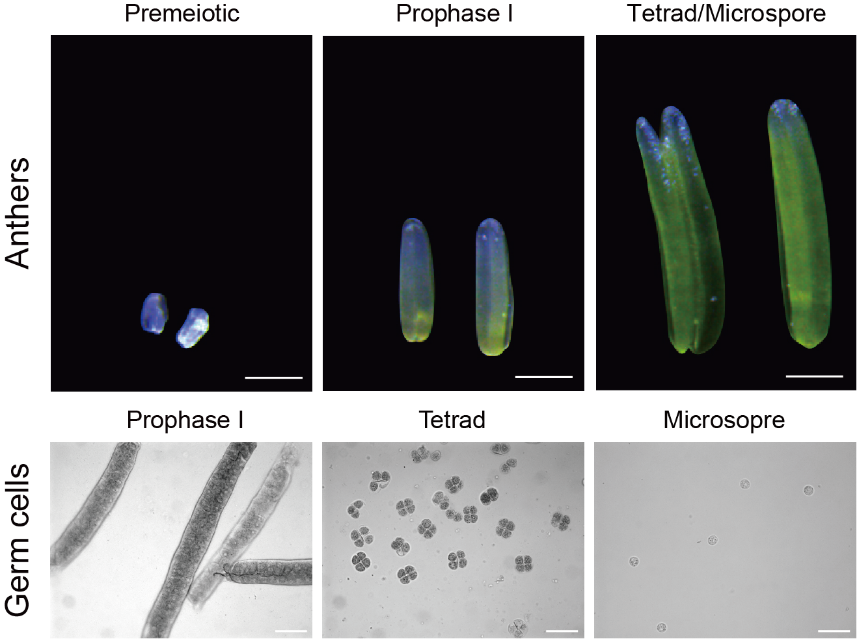 Fig. 1. Maize anthers and male germ cells at various developmental stages
<関連情報>
トウモロコシの雄しべにおける21塩基対のファジRNAによる標的mRNAの切断の空間的・時間的調節 Spatiotemporal regulation of target mRNA cleavage by 21-nt phasiRNAs in maize anthers
Bi Lian lianbi, Tianxiao Huang, Wei Huang , +2 , and Yijun Qi
Proceedings of the National Academy of Sciences Published:June 11, 2025
DOI:https://doi.org/10.1073/pnas.2422647122
Significance
21-nt phasiRNAs in grasses play crucial roles in anther development and male reproduction. The targets they regulate remain largely unknown in maize. This study reveals that they direct the cleavage of hundreds of target mRNAs in maize. While 21-nt phasiRNAs in anthers (somatic anther wall cells) target genes implicated in stress response and cellular homeostasis, 21-nt phasiRNAs in male germ cells target genes related to meiotic processes. Despite the conserved mode of action of 21-nt phasiRNAs in maize and rice, their sequences and targets show low conservation, suggesting fast divergence of 21-nt phasiRNAs and their targets in grasses.
Abstract
21-nt phasiRNAs are abundantly expressed in anthers and play crucial roles in anther development and male reproduction in grasses. In maize, the target genes that 21-nt phasiRNAs regulate remain largely unknown. Here, we show that 21-nt phasiRNAs direct the cleavage of hundreds of target mRNAs in maize. Interestingly, while 21-nt phasiRNAs in anthers (somatic anther wall cells) do not have obvious preference for a particular nucleotide at the 5′ end and target genes implicated in stress response and cellular homeostasis, 21-nt phasiRNAs in male germ cells preferentially initiate with 5′ C and target genes related to meiotic processes in a ZmAGO5c-dependent manner. Our results indicate that mRNA cleavage is a conserved mechanism used by 21-nt phasiRNAs for gene regulation in grasses. However, the sequences of 21-nt phasiRNAs and their targets show little conservation in maize and rice, suggesting that 21PHAS loci and 21-nt phasiRNA targets have undergone fast divergence in grasses.