2025-08-06 NASA
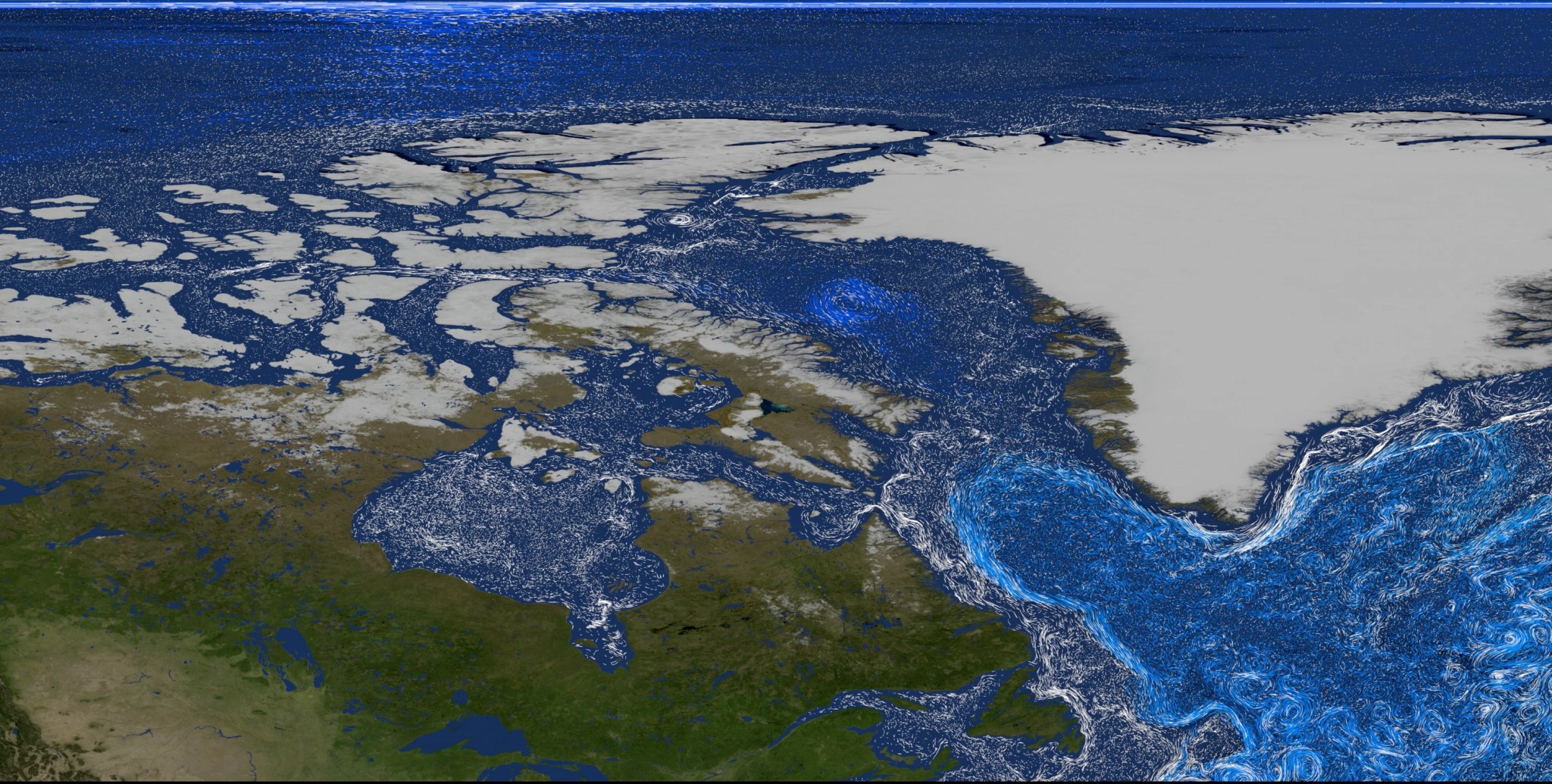
Ocean currents swirl around North America (center left) and Greenland (upper right) in this data visualization created using NASA’s ECCO model. Advanced computing is helping oceanographers decipher hot spots of phytoplankton growth.
NASA’s Scientific Visualization Studio
<関連情報>
- https://www.nasa.gov/earth/nasa-supercomputers-take-on-life-near-greenlands-most-active-glacier/
- https://www.nature.com/articles/s43247-025-02599-1
- https://www.science.org/doi/10.1126/science.aay8380
グリーンランドで最も活発な氷河からの融解量の増加が沿岸の生産性を高めている Increased melt from Greenland’s most active glacier fuels enhanced coastal productivity
Michael Wood,Dustin Carroll,Ian Fenty,Clément Bertin,Basil Darby,Stephanie Dutkiewicz,Mark Hopwood,Ala Khazendar,Lorenz Meire,Hilde Oliver,Tara Parker & Josh Willis
Communications Earth & Environment Published:05 August 2025
DOI:https://doi.org/10.1038/s43247-025-02599-1
Abstract
Seasonal phytoplankton blooms in Greenland’s coastal waters form the base of marine food webs and contribute to oceanic carbon uptake. In Qeqertarsuup Tunua, West Greenland, a secondary summertime bloom follows the Arctic spring bloom, enhancing annual primary productivity. Emerging evidence links this summer bloom to subglacial discharge from Sermeq Kujalleq, the most active glacier on the Greenland Ice Sheet. This discharge drives localized upwelling that may alleviate nutrient limitation in surface waters, yet this mechanism remains poorly quantified. Here, we employ a high-resolution biogeochemical model nested within a global state estimate to assess how discharge-driven upwelling influences primary productivity and carbon fluxes. We find that upwelling increases summer productivity by 15–40% in Qeqertarsuup Tunua, yet annual carbon dioxide uptake rises by only ~3% due to reduced solubility in plume-upwelled waters. These findings suggest that intensifying ice sheet melt may alter Greenland’s coastal productivity and carbon cycling under future climate scenarios.
植物プランクトンの濃度の変化が北極海の初級生産量の増加を駆動している Changes in phytoplankton concentration now drive increased Arctic Ocean primary production
K. M. Lewis, G. L. van Dijken, and K. R. Arrigo
Science Published:10 Jul 2020
DOI:https://doi.org/10.1126/science.aay8380
Food for thought
Phytoplankton abundances in the Arctic Ocean have been increasing over recent decades as the region has warmed and sea ice has disappeared. The presumptive causes of this increase were expanding open water area and a longer growing season—at least until now. Lewis et al. show that although these factors may have driven the productivity trends before, over the past decade, phytoplankton primary production rose by more than half because of increased phytoplankton concentrations (see the Perspective by Babin). This finding means that there has been an influx of new nutrients into the region, suggesting that the Arctic Ocean could become more productive and export additional carbon in the future.
Science, this issue p. 198; see also p. 137
Abstract
Historically, sea ice loss in the Arctic Ocean has promoted increased phytoplankton primary production because of the greater open water area and a longer growing season. However, debate remains about whether primary production will continue to rise should sea ice decline further. Using an ocean color algorithm parameterized for the Arctic Ocean, we show that primary production increased by 57% between 1998 and 2018. Surprisingly, whereas increases were due to widespread sea ice loss during the first decade, the subsequent rise in primary production was driven primarily by increased phytoplankton biomass, which was likely sustained by an influx of new nutrients. This suggests a future Arctic Ocean that can support higher trophic-level production and additional carbon export.