2025-07-17 中国科学院(CAS)
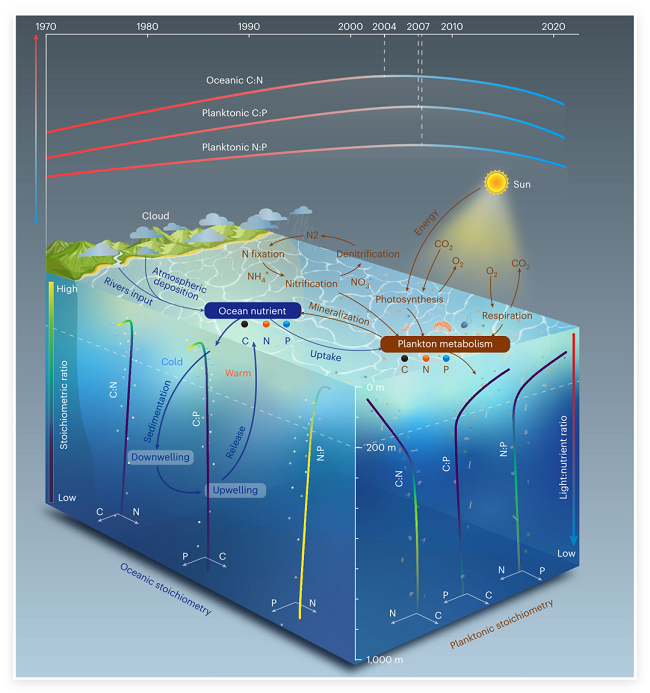
Conceptual diagram of the spatiotemporal variation in marine carbon, nitrogen, and phosphorus stoichiometry. (Image by LIU Ji)
<関連情報>
- https://english.cas.cn/newsroom/research_news/earth/202507/t20250717_1047555.shtml
- https://www.nature.com/articles/s41561-025-01735-y
過去50年間の海洋生態系化学量論における地球規模のシフト Global-scale shifts in marine ecological stoichiometry over the past 50 years
Ji Liu,Hai Wang,Juan Mou,Josep Penuelas,Manuel Delgado-Baquerizo,Adam C. Martiny,Guiyao Zhou,David A. Hutchins,Keisuke Inomura,Michael W. Lomas,Mojtaba Fakhraee,Adam Pellegrini,Tyler J. Kohler,Curtis A. Deutsch,Noah Planavsky,Brian Lapointe,Yong Zhang,Yanyan Li,Jiacong Zhou,Yixuan Zhang,Siyi Sun,Yong Li,Wei Zhang,Junji Cao & Ji Chen
Nature Geoscience Published:03 July 2025
DOI:https://doi.org/10.1038/s41561-025-01735-y
Abstract
The elemental stoichiometry of carbon (C), nitrogen (N) and phosphorus (P) regulates marine biogeochemical cycles and underpins the Redfield ratio paradigm. However, its global variability and response to environmental change remain poorly constrained. Here we compile a global dataset of 56,031 plankton (particulate) and 388,515 seawater (dissolved) samples from 1971 to 2020, spanning surface to 1,000 m depth, to assess spatial and temporal dynamics in marine C:N:P ratios. We show that planktonic C:P and N:P, and oceanic C:N and C:P ratios, consistently exceed Redfield ratio throughout the study period, indicating widespread deviation from canonical stoichiometry. Planktonic C:N and N:P ratios rose markedly in the late twentieth century, followed by a decline, suggesting a progressive alleviation of P limitation, probably driven by increased anthropogenic P inputs. Depth-resolved patterns show decreasing oceanic C:N and C:P, and increasing N:P ratios with depth, attributable to differential remineralization and microbial nutrient cycling. Our findings highlight dynamic, non-static stoichiometric patterns over decadal scales, offering critical observational constraints for refining the representation of elemental cycling in biogeochemical models and improving projections of marine ecosystem responses to global change.