2025-07-21 中国科学院(CAS)
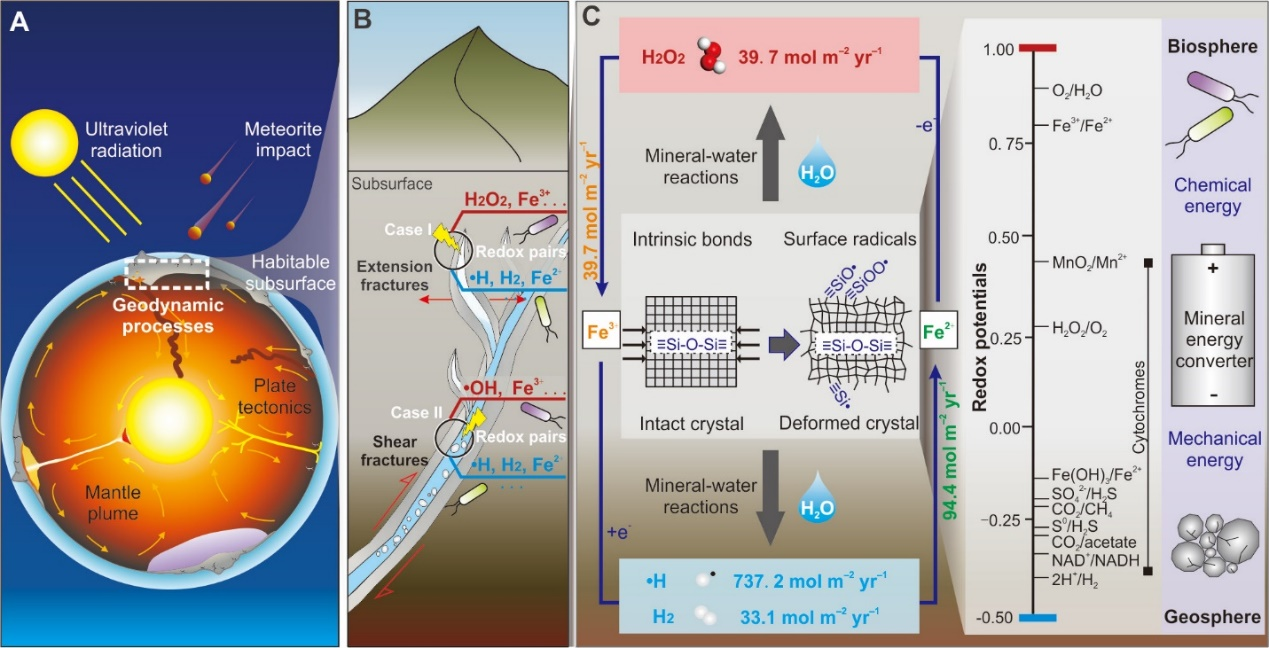 Schematic for redox chemistry driven by mechanical processes in the deep subsurface on rocky planets. (A) The formation of habitable environments in the subsurface as silicate crusts are reworked by various geological processes such as crust deformation, plate tectonics and mantle plumes. (B) Microbes utilize the energy and electrons for cell growth and division in fracture systems where redox gradients exist. (C) Mineral-water reactions convert mechanical energy to chemical energy and drive iron redox cycling in the deep biosphere. (Image by Dr. WU Xiao)
<関連情報>
- https://english.cas.cn/newsroom/research_news/earth/202507/t20250718_1047623.shtml
- https://www.science.org/doi/10.1126/sciadv.adx5372
地殻断層が地下深部の生物学的酸化還元サイクルを駆動する Crustal faulting drives biological redox cycling in the deep subsurface
Xiao Wu, Jianxi Zhu, Hongmei Yang, Yiping Yang, […] , and Hongping He
Science Advances Published:18 Jul 2025
DOI:https://doi.org/10.1126/sciadv.adx5372
Abstract
In the deep biosphere, where surface-derived substrates are depleted, microbial communities rely on redox pairs generated through water-rock reactions to sustain metabolism. A notable example of this is the production of hydrogen gas (H2) and oxidants from rock fracturing. However, the potential interactions between these initial redox pairs and a key subsurface element—iron (Fe)—remain underexplored. Here, we simulated radical-induced water splitting to investigate the formation and evolution of redox gradients. Our results show that in the presence of Fe, ferrous iron (Fe2+) was marginally oxidized to ferric iron (Fe3+) by low concentrations of oxidants, whereas Fe3+ was efficiently reduced back to Fe2+ by reactive hydrogen atoms (•H). We propose that crustal faulting can generate various redox pairs and drive Fe redox cycling, thereby providing a sustained energy source for subsurface life on Earth and potentially on other planetary bodies.