2025-07-16 コロンビア大学
<関連情報>
- https://news.columbia.edu/news/natural-areas-may-acquire-too-little-nitrogen-repair-climate
- https://www.nature.com/articles/s41586-025-09201-w
世界の陸域窒素固定と農業によるその改変 Global terrestrial nitrogen fixation and its modification by agriculture
Carla R. Reis Ely,Steven S. Perakis,Cory C. Cleveland,Duncan N. L. Menge,Sasha C. Reed,Benton N. Taylor,Sarah A. Batterman,Christopher M. Clark,Timothy E. Crews,Katherine A. Dynarski,Maga Gei,Michael J. Gundale,David F. Herridge,Sarah E. Jovan,Sian Kou-Giesbrecht,Mark B. Peoples,Johannes Piipponen,Emilio Rodríguez-Caballero,Verity G. Salmon,Fiona M. Soper,Anika P. Staccone,Bettina Weber,Christopher A. Williams & Nina Wurzburger
Nature Published:16 July 2025
DOI:https://doi.org/10.1038/s41586-025-09201-w
Abstract
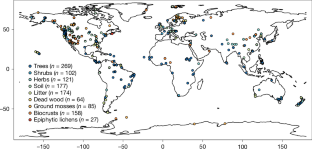
Biological nitrogen fixation (BNF) is the largest natural source of new nitrogen (N) that supports terrestrial productivity1,2, yet estimates of global terrestrial BNF remain highly uncertain3,4. Here we show that this uncertainty is partly because of sampling bias, as field BNF measurements in natural terrestrial ecosystems occur where N fixers are 17 times more prevalent than their mean abundances worldwide. To correct this bias, we develop new estimates of global terrestrial BNF by upscaling field BNF measurements using spatially explicit abundances of all major biogeochemical N-fixing niches. We find that natural biomes sustain lower BNF, 65 (52–77) Tg N yr−1, than previous empirical bottom-up estimates3,4, with most BNF occurring in tropical forests and drylands. We also find high agricultural BNF in croplands and cultivated pastures, 56 (54–58) Tg N yr−1. Agricultural BNF has increased terrestrial BNF by 64% and total terrestrial N inputs from all sources by 60% over pre-industrial levels. Our results indicate that BNF may impose stronger constraints on the carbon sink in natural terrestrial biomes and represent a larger source of agricultural N than is generally considered in analyses of the global N cycle5,6, with implications for proposed safe operating limits for N use7,8.