2025-06-23 森林総合研究所飛島建設株式会社技術研究所,ソイルウッド
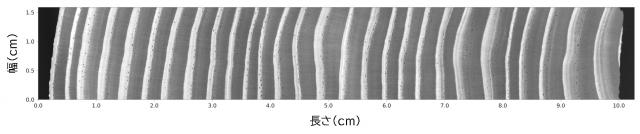
図1 丸太断面の軟X線写真
厚さ2mmの試験体に軟X線を照射して得た試験体のイメージ。密度が高い部分が白く、密度が低い部分は暗く描画されます。
<関連情報>
- https://www.ffpri.go.jp/press/2025/20250623/index.html
- https://www.ffpri.go.jp/press/2025/20250623/documents/20250623press.pdf
- https://jwoodscience.springeropen.com/articles/10.1186/s10086-025-02198-w
密度分布解析による酸素欠乏土壌に埋設された木造基礎杭の炭素吸収ポテンシャルの評価 Evaluation of the carbon sink potential of wooden foundation piles embedded in oxygen-depleted soils using density profile analysis
Ikuo Momohara,Kana Yamashita,Yuka Miyoshi,Takumi Murata & Atsunori Numata
Journal of Wood Science Published:14 May 2025
DOI:https://doi.org/10.1186/s10086-025-02198-w
Abstract
Wooden foundation piles are a renewable resource that contributes to mitigating climate change because of the minimal processing requirements and remarkably long service life. Previous studies have shown that while these piles can have a long service life, the buried wood is also susceptible to bacterial activity; however, the extent to which this affects the carbon stock in wooden piles remains uncertain. This study addressed this by estimating the decrease in the mass of a pile buried in soil using the density profile, because bacterially induced deterioration was observed to initiate on the pile surface. Piles extracted from various locations in Japan were prepared as thin specimen strips. Then, these specimens were exposed to soft X-rays, and the resulting images were acquired on film. The images were analyzed to calculate the mean wood density at 0.5 cm intervals from the pile surface. The results revealed that no significant decrease in density was observed near the surface of a pile, indicating that the bacterial effect on the carbon stock was negligible when a pile was installed in waterlogged conditions. By contrast, the possibility remains that piles exposed to oxygen-depleted conditions, such as fluctuating groundwater levels, might have experienced a reduction of approximately 10% of their initial mass after 60–84 years of exposure to soil conditions. This reduction in mass is significantly lower than the 50% reduction observed in lumber after 35 years and wooden panels after 25 years; therefore, wooden foundation piles have promising potential as carbon sinks.