
2026-04-03 シカゴ大学
<関連情報>
- https://news.uchicago.edu/story/scientists-discover-most-chemically-pristine-star-yet-found-universe
- https://www.nature.com/articles/s41550-026-02816-7
大マゼラン雲にある、ほぼ原形を保った星 A nearly pristine star from the Large Magellanic Cloud
Alexander P. Ji,Vedant Chandra,Selenna Mejias-Torres,Zhongyuan Zhang,Philipp Eitner,Kevin C. Schlaufman,Hillary Diane Andales,Ha Do,Natalie M. Orrantia,Rithika Tudmilla,Pierre N. Thibodeaux,Keivan G. Stassun,Madeline Howell,Jamie Tayar,Maria Bergemann,Andrew R. Casey,Jennifer A. Johnson,Joleen K. Carlberg,William Cerny,José G. Fernández-Trincado,Keith Hawkins,Juna A. Kollmeier,Chervin F. P. Laporte,Guilherme Limberg,… Riley Thai
Nature Astronomy Published:03 April 2026
DOI:https://doi.org/10.1038/s41550-026-02816-7
Abstract
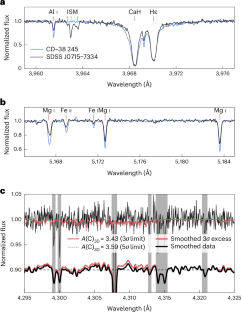
The first stars formed out of pristine gas, causing them to be so massive that none are expected to have survived until today. If their direct descendants were sufficiently low-mass stars, such stars could exist today and would be recognizable by having the lowest metallicities (abundance of elements heavier than helium). Here we present the independent identification and detailed chemical analysis of the star SDSS J0715−7334, finding ultralow elemental abundances of both iron and carbon ([Fe/H] = −4.3, [C/Fe] < −0.2) and total metallicity Z < 7.8 × 10⁻⁷ (log Z/Z⊙ < −4.3). The star’s orbit indicates that it originates from the halo of the Large Magellanic Cloud. Its heavy element abundance pattern can be explained by a primordial supernova with an initial mass of 30 solar masses. This star is over ten times more chemically pristine than the most extreme high-redshift galaxies currently found by the James Webb Space Telescope. It is sufficiently metal-poor that current models of low-mass star formation require dust cooling to explain its existence.


