2026-03-27 北里大学

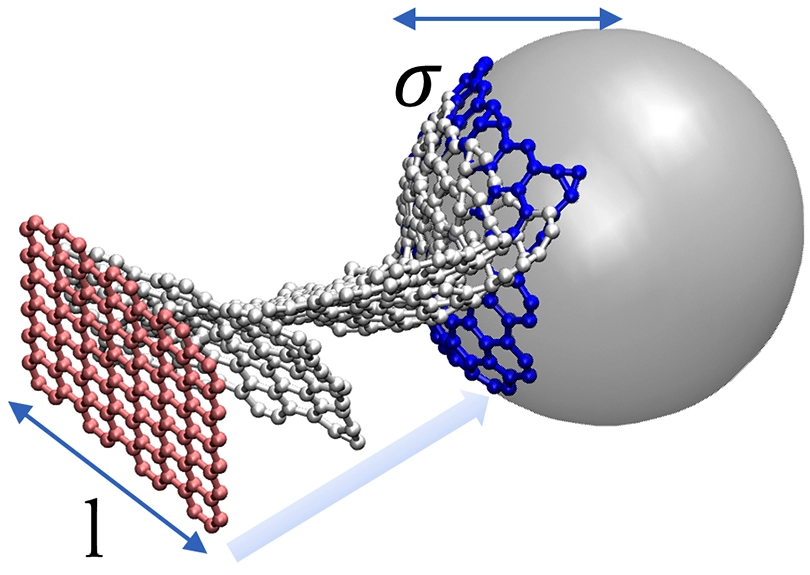
本研究の概要図
<関連情報>
- https://www.kitasato.ac.jp/jp/news/20260327-01.html
- https://www.kitasato.ac.jp/jp/albums/abm.php?f=abm00048457.pdf&n=20260327_プレスリリース「なぜ三脚型分子は固体表面上できれいに並ぶのか?」.pdf
- https://pubs.rsc.org/en/content/articlelanding/2026/nh/d5nh00837a
固体表面上における三脚型トリプチセンの配向と六方晶秩序に関する分子動力学シミュレーションによる考察 Molecular dynamics insights into orientation and hexagonal ordering of tripodal triptycenes on solid surfaces
Kaito Nitta,Yoshiaki Shoji,Takanori Fukushima and Go Watanabe
Nanoscale Horizons Published:26 Mar 2026
DOI:https://doi.org/10.1039/D5NH00837A
Abstract
Triptycene derivatives bearing long alkoxy chains at the 1,8,13- or 1,8-positions have been demonstrated to self-assemble on solid substrates into highly ordered thin films featuring a two-dimensional (2D) nested hexagonal packing of the triptycene moieties and a one-dimensional (1D) stacking layer. Although the bulk-phase structures of these derivatives have been clarified, the molecular-level mechanism governing their assembly near solid interfaces remains elusive. Here, we performed all-atom molecular dynamics (MD) simulations to investigate three triptycene derivatives (Trip1, Trip2, and Trip3) with different alkoxy-chain substitution patterns, revealing their assembly structures, thermodynamic stabilities, and interfacial ordering processes. Our simulations showed that antiparallel molecular alignment is thermodynamically stable in bulk assemblies, whereas thin films preferentially adopt a parallel alignment, indicating that solid interfaces promote this orientation. Furthermore, thermal annealing of stair-stepped trilayers drove their transformation into flat bilayers and the growth of hexagonally ordered domains, quantified by radial distribution functions and hexatic order parameters. Comparative analysis demonstrated that alkoxy substitution patterns dictate packing density, structural order, and phase stability, in excellent agreement with experimental observations. These findings provide molecular-level insights into interface-driven self-assembly and establish design principles for constructing thermodynamically stable, highly ordered organic thin films, enabling simulation-guided strategies for next-generation nanoscale materials design.