2026-03-25 九州大学
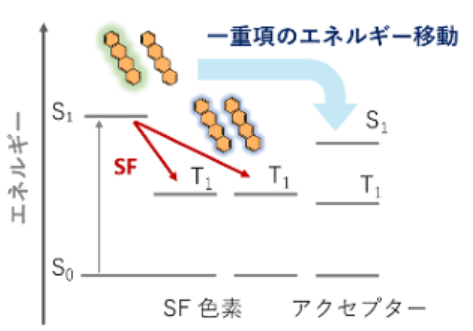
図1 SF材料のエネルギーダイアグラム。SF材料においては、1光子で2つの励起子を生成できるため、太陽電池のショックレー・クワイサー限界を克服できる。エネルギーアクセプターへの一重項エネルギー移動を回避したエネルギー準位設計が重要となる。
<関連情報>
- https://www.kyushu-u.ac.jp/ja/researches/view/1435
- https://www.kyushu-u.ac.jp/f/65181/26_0325_01.pdf
- https://pubs.acs.org/doi/10.1021/jacs.5c20500
一重項分裂二量体から近赤外発光スピン反転エミッターに至るスピン状態選択的収穫経路の探求 Exploring Spin-State Selective Harvesting Pathways from Singlet Fission Dimers to a Near-Infrared-Emissive Spin-Flip Emitter
Percy Gonzalo Sifuentes-Samanamud,Adrian Sauer,Aki Masaoka,Yuta Sawada,Yuya Watanabe,Ilias Papadopoulos,Katja Heinze,Yoichi Sasaki,and Nobuo Kimizuka
Journal of the American Chemical Society Published: March 25, 2026
DOI:https://doi.org/10.1021/jacs.5c20500
Abstract
Singlet fission (SF), a photophysical process generating two triplet excitons from one singlet exciton, has the potential to boost efficiency in photovoltaics and organic light-emitting diodes. Previous studies on energy-level control and intermolecular interactions have identified key factors for maximizing the efficiency of the initial SF process. However, in isothermic/endothermic SF systems, such as tetracene derivatives, the subsequent sensitization process becomes less efficient in the presence of a competing Förster resonance energy transfer (FRET) process. Here, we demonstrate that a molybdenum-based near-infrared light-emitting spin-flip emitter serves as a triplet-selective energy acceptor from triplet states of tetracene-based dimers generated by SF. The large energy gap existing between the spin-allowed transitions and the luminescent spin-flip transition of the molybdenum complex allowed efficient exothermic triplet energy transfer (TET) to the spin-flip excited doublet state of the complex while circumventing the FRET from the initially formed tetracene singlet state to the high-energy spin-allowed states of the complex. The quantum yields of the doublet state formation of the molybdenum complex by tetracene-based SF dimers with phenylene, 2,5-methylphenylene, and p-terphenylene bridging units were quantified to be 112 ± 6%, 132 ± 2%, and 128 ± 4%, respectively, in solution. The drop of fluorescence lifetimes of the SF dimers at high concentrations of the molybdenum complex implies energy transfer from exchange-coupled triplet pairs, highlighting the importance of controlling exchange interaction and triplet pair recombination. This work represents a significant step toward developing exciton/photon amplification materials by combining SF materials with transition-metal complexes, advancing the application of SF beyond conventional limitations.