2026-03-25 中国科学院 (CAS)
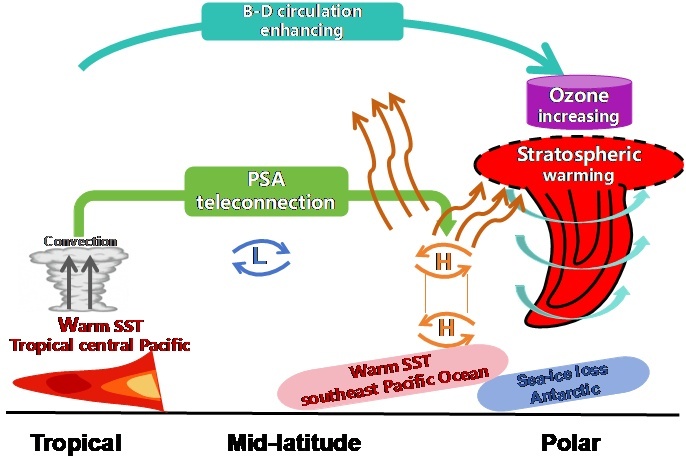
Diagram illustrates the proposed physical mechanism linking boreal winter Niño 4 SST anomalies to Antarctic stratospheric warming in the subsequent austral winter. (Image by ZI Yucheng)
<関連情報>
- https://english.cas.cn/newsroom/research-news/202603/t20260324_1153235.shtml
- https://acp.copernicus.org/articles/26/2117/2026/
熱帯中央太平洋における海面水温異常が南極成層圏に及ぼす季節をまたいだ影響 Cross-Seasonal Impact of SST Anomalies over the Tropical Central Pacific Ocean on the Antarctic Stratosphere
Yucheng Zi, Zhenxia Long, Jinyu Sheng, Gaopeng Lu, Will Perrie, and Ziniu Xiao
Atmospheric Chemistry and Physics Published:10 Feb 2026
DOI:https://doi.org/10.5194/acp-26-2117-2026
Abstract
In this study we examine the cross–seasonal effects of boreal winter sea surface temperature (SST) anomalies over the tropical central Pacific (Niño 4 region) on Antarctic stratospheric circulation and ozone transport during the subsequent austral winter using ERA5 reanalysis of 45 years (1980–2024). Our analyses show that warm (cold) SST anomalies in the Niño 4 region during December–February are associated with mid- and high-latitude stratospheric warming (cooling), a contracted (expanded) stratospheric polar vortex (SPV), and enhanced (suppressed) polar ozone concentrations in the subsequent July–September period. This delayed response is mediated by the Pacific–South America (PSA) teleconnection pattern, which excites planetary waves that propagate upward into the stratosphere, thereby modifying the Brewer–Dobson circulation and enhancing ozone poleward transport, ultimately warming polar stratosphere. In addition, as the influence of the Niño 4 SST anomalies on the PSA teleconnection pattern diminishes during July–September, surface heat feedback at mid- and high-latitude becomes critically important for planetary waves. For example, persistent southeastern Pacific SST warming and sea–ice loss over the Amundsen and Ross Seas reinforce planetary waves by releasing heat from ocean into atmosphere. A multivariate regression statistical model using factors of boreal winter Niño 4 SST and June PSA indices explains approximately 32 % of the variance in austral winter stratospheric temperatures. These findings highlight a previously underexplored pathway through which tropical Pacific SST anomalies modulate Antarctic stratospheric dynamics on cross-seasonal timescales.