
2026-03-24 ペンシルベニア州立大学(Penn State)
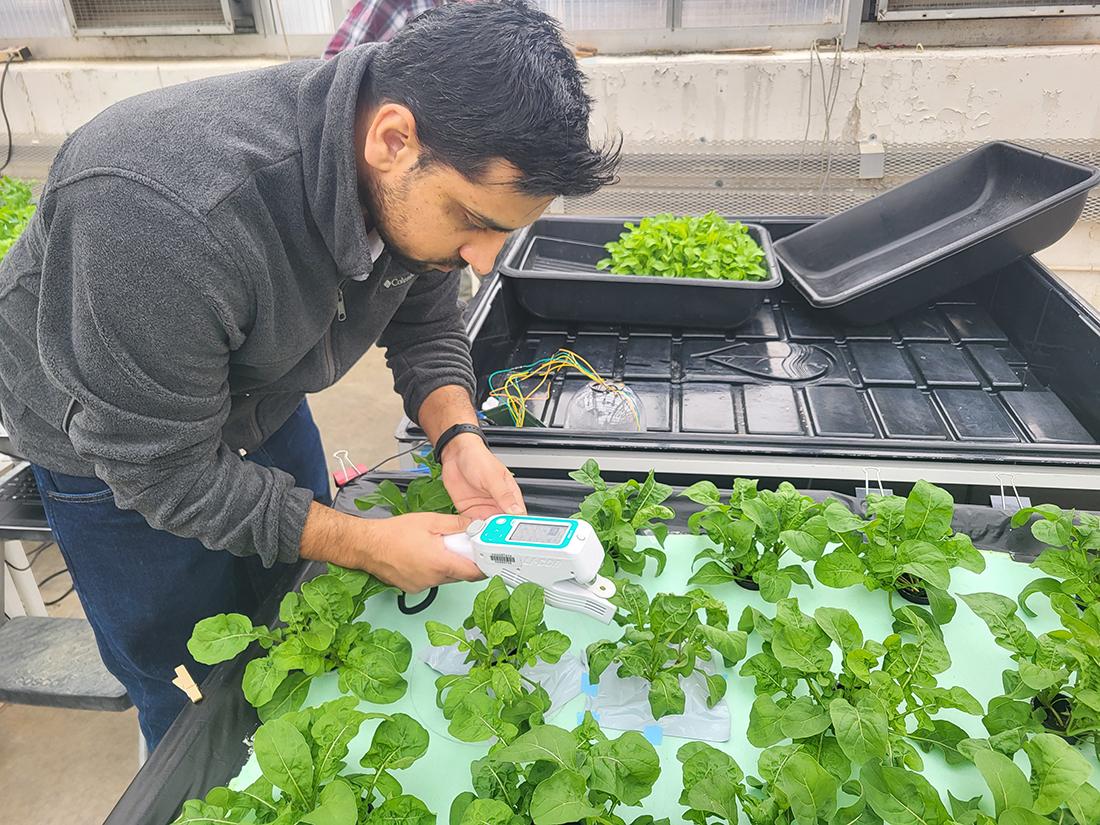
To confirm the sensor system’s accuracy, study first author Ali Ahmad measures the plants’ physical traits, such as growth, leaf condition and physiological responses. The researchers found that the sensor network achieved up to 99.15% accuracy in identifying plant stress levels. Credit: Penn State.
<関連情報>
- https://www.psu.edu/news/research/story/low-cost-sensor-system-could-warn-farmers-salt-stress-plants
- https://ieeexplore.ieee.org/document/11278484
ルッコラの塩ストレスを非侵襲的に検出するための新しいMQベースセンサーシステム Novel MQ-Based Sensor System for Noninvasive Detection of Salt Stress in Arugula
Ali Ahmad; Francesco Di Gioia; Sandra Sendra; Jaime Lloret
IEEE Sensors Journal Published:05 December 2025
DOI:https://doi.org/10.1109/JSEN.2025.3637393
Abstract
Timely detection of abiotic stress is critical for precision agriculture, enabling early intervention and sustainable crop management. This study introduces a novel, nondestructive sensor system for real-time detection of salinity stress in hydroponically grown arugula [Eruca sativa (Mill.) Thell.] using low-cost metal–oxide–semiconductor (MOS) gas sensors. Arugula plants were cultivated under controlled greenhouse conditions and exposed to three salinity levels [0-, 40-, and 80-mM sodium chloride (NaCl)]. Volatile organic compounds (VOCs) emissions from plants were captured using a dome-based enclosure equipped with MQ2, MQ135, and MQ137 sensors and continuously recorded over eight days. Sensor outputs revealed distinct VOC patterns associated with increasing salinity stress, validated through physiomorphological measurements. A machine learning (ML) pipeline—comprising K-nearest neighbors (KNNs), support vector machine (SVM), and random forest (RF) classifiers—was trained on the VOC data, achieving up to 99.15% accuracy in identifying stress levels. Configurations using the full sensor array consistently outperformed single- and dual-sensor models, both in terms of classification performance and confidence. The system employed wireless sensor network (WSN) architecture to enable scalable and distributed environmental monitoring. Each node integrated an Arduino Mega 2560 for analog signal acquisition and was connected to a Raspberry Pi 4, serving as a gateway for the WSN. Data were then structured and stored in a MariaDB database. This work is the first to demonstrate the use of low-cost gas sensors for VOC-based salt stress detection in arugula, offering a promising tool for early stress diagnosis in controlled-environment agriculture. The approach provides a scalable, real-time solution to enhance crop monitoring, with potential applications across a wide range of crops and stress conditions.

