2026-03-24 東北大学
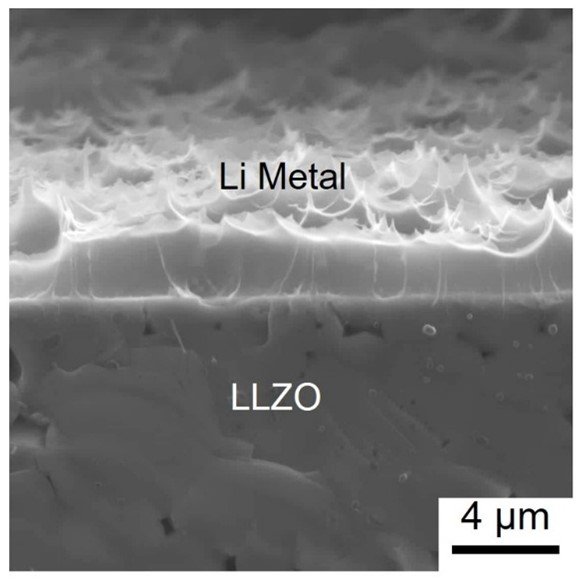
図1. 室温で数秒間の超音波接合により形成された、リチウムと固体電解質の界面断面像
<関連情報>
- https://www.tohoku.ac.jp/japanese/2026/03/press20260324-02-Lithium.html
- https://www.tohoku.ac.jp/japanese/newimg/pressimg/tohokuuniv-press20260324_02web_Lithium.pdf
- https://onlinelibrary.wiley.com/doi/10.1002/sstr.202500866
ガーネット固体電解質とリチウム金属の超音波溶接:数秒で密着した界面接触を実現 Ultrasonic Welding of Garnet Solid Electrolytes to Lithium Metal: Achieving Intimate Interfacial Contact in Seconds
Mikihisa Fukuda, Ying Li, Run-Zi Wang, Shin-ichi Orimo, Yutaka S. Sato, Hidemi Kato, Eric Jianfeng Cheng
Small Structures Published: 19 March 2026
DOI:https://doi.org/10.1002/sstr.202500866
Abstract
Solid-state batteries (SSBs) are widely regarded as promising next-generation energy storage technology due to their potential for enhanced safety and higher energy density compared to conventional Li-ion batteries. Among the various oxide solid electrolytes, garnet Li7La3Zr2O12 (LLZO) is considered one of the most promising, yet the Li–LLZO solid–solid interface remains a major bottleneck. Both LLZO and the relatively stiff Li metal anode rapidly accumulate Li2CO3 surface impurities and form limited contact, leading to large interfacial resistance. Here, we demonstrate that ultrasonic welding (USW) provides a rapid, mechanically driven route to establish intimate Li–LLZO contact within seconds. A preliminary ambient-air experiment confirms the basic feasibility of the technique, while all controlled welding experiments performed in Ar yield Li/LLZO interfaces with resistances on the order of several hundred Ω cm2. Systematic comparison of pyramidal and flat horn geometries reveals that uniform pressure delivery is essential for stable interfacial formation, with the flat horn reducing the resistance to approximately 225 Ω cm2. Furthermore, introducing a sputtered Au interlayer significantly enhances mechanical conformity and wetting by compensating LLZO surface roughness and enabling Li to more effectively accommodate LLZO surface asperities. As a result, the interfacial resistance decreases to as low as 1.5 Ω cm2, among the lowest values reported for garnet–Li interfaces processed at room temperature. This study demonstrates USW as an effective mechanical strategy for constructing low-resistance Li–garnet interfaces suitable for next-generation SSBs.