
2026-03-19 テキサス大学オースチン校
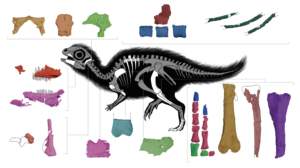
The skeletal anatomy of a juvenile Doolysaurus huhmini. The graphic highlights the fossil bones that were found with the dinosaur. Artwork: Janet Cañamar, adapted from Jung et al 2026.
<関連情報>
- https://news.utexas.edu/2026/03/19/fossil-x-ray-reveals-new-species-of-baby-dino-named-for-iconic-korean-cartoon/
- https://fr.pensoft.net/article/178152/
韓国で発見された新種の恐竜と、それが初期に分岐した新鳥盤類の多様性に及ぼす影響 A new dinosaur species from Korea and its implications for early-diverging neornithischian diversity
Jongyun Jung, Minguk Kim, Hyemin Jo, Julia A. Clarke
Fossil Record Published:19 Mar 2026
DOI:https://doi.org/10.3897/fr.29.178152
Abstract
The Korean dinosaur fossil record is exceptionally rich in trackways and eggs, yet skeletal remains are exceedingly rare. Two species have been described based on postcranial elements, and a taxon known from cranial materials has not yet been reported. Here, we report a new early-diverging neornithischian species, known from a small, partially articulated skeleton comprising cranial and postcranial elements as well as gastroliths. The specimen is from the mid-Cretaceous Ilseongsan Formation of Aphae Island (Aphaedo). X-ray micro-computed tomography (micro-CT) revealed the anatomy of the new species, including the first studied cranial remains of a dinosaur from Korea. The size and anatomical features of the specimen, along with histological analysis, indicate that it is not a fully grown individual, probably 0–2 years old. Gastroliths are present, with morphologies and a relative mass proposed to be consistent with a more omnivorous diet. Phylogenetic analyses recover the new species, Doolysaurus huhmini gen. et sp. nov., as a thescelosaurid. The recovery of Doolysaurus with most other Asian thescelosaurids near the base of this clade provides further evidence for its origin and early biogeography. The new discovery suggests that other small dinosaur fossils may be found at Aphaedo or at sites with similar taphonomic conditions in Korea; Doolysaurus is consistent with richer dinosaurian diversity in the Cretaceous of Korea than is represented in its rich trace fossil record.


