2026-03-19 合肥物質科学研究院(HFIPS)
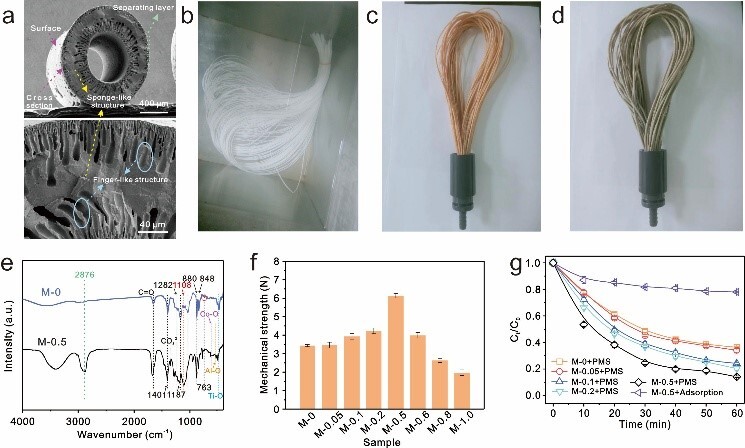
CoAl-LDH/Ti3C2Tx@PVDF hollow fiber catalytic membrane and properties. (Image by XIE Chao)
<関連情報>
- https://english.hf.cas.cn/nr/rn/202603/t20260319_1152985.html
- https://www.sciencedirect.com/science/article/abs/pii/S1385894726009368
- https://www.sciencedirect.com/science/article/abs/pii/S0304389425017339
- https://www.sciencedirect.com/science/article/abs/pii/S0304389425001876
高負荷密度Fe₃O₄ / Ti₃C₂Tₓ @ PVDF触媒膜システムによるアセトアミノフェンの効率的な分解と医薬品廃水の高度処理 Efficient acetaminophen degradation and advanced treatment of pharmaceutical wastewater by high loading density Fe3O4/Ti3C2Tx@PVDF catalytic membranes system
Chao Xie, Weikai. Kong, Zijian Wu, Dandan Yang, Yahui Li, Yulian Li, Jiandong Lu, Junyong He, Peidong Hong, Lingtao Kong
Chemical Engineering Journal Available online: 27 January 2026
DOI:https://doi.org/10.1016/j.cej.2026.173477
Highlights
- A novel Fe3O4/Ti3C2Tx@PVDF catalytic membrane was successfully fabricated.
- The excellent ACT degradation performance due to Fe3O4/Ti3C2Tx heterojunction.
- An integrated MBR + CMR process was developed for real pharmaceutical wastewater.
- The robust stability efficacy of the M-5 + PMS system were witnessed.
Abstract
The filtration-assembled catalytic composite membrane enable high-density catalyst loading with improved exposure of active sites. Given the cost efficiency of iron-based catalysts, inhere, a high-density Fe3O4/Ti3C2Tx@PVDF catalytic composite membrane was successfully fabricated via filtration-assembled anchoring Fe3O4 nanoparticles to the superior surface of Ti3C2Tx. The structural and functional properties of the composite membrane were systematically elucidated through comprehensive characterization. Leveraging the outstanding catalytic performance of Fe3O4/Ti3C2Tx, efficient degradation of acetaminophen (ACT) was achieved. In the ∙OH dominated M-5 + PMS system, 93.2% ACT removal was attained within 60 min. The degradation pathways and underlying mechanisms were thoroughly investigated. Furthermore, a novel MBR + CMR system was developed for advanced treatment of pharmaceutical wastewater, significantly enhancing the removal of pollutants from secondary effluent. The hybrid system exhibited remarkable treatment efficiencies, with 91.7% TOC removal and 99.7% NH4+-N removal. Finally, future perspectives on scalable membrane fabrication, potential application domains, and technology integration are discussed.
超低Cu(I)負荷により、自己洗浄型Cu2O/Ti3C2Tx@PVDF触媒膜統合システムにおいて、超高耐汚染性と除染性能を実現 Ultra-low Cu(I) loading achieving ultra-high fouling-resistance and decontamination performance in a self-cleaning Cu2O/Ti3C2Tx@PVDF catalytic membrane integrated system
Chao Xie, Pengyu Zhang, Yi Hu, Dandan Yang, Yahui Li, Yulian Li, Jiandong Lu, Zijian Wu, Junyong He, Peidong Hong, Lingtao Kong
Journal of Hazardous Materials Available online: 2 June 2025
DOI:https://doi.org/10.1016/j.jhazmat.2025.138817
Highlights
- Cu2O/Ti3C2Tx@PVDF membrane with ultra-low Cu(I) loading was strategically prepared.
- Membrane integrated system works well in a wide pH range in complex water matrices.
- Intrinsic Cu(I)/Cu(II) redox cycle accelerates PMS activation and ROS generation.
- Ultra-high fouling-resistance was demonstrated, the average FRR is 94.93 %.
- TBBPA exhibits reduced ecotoxicity in the filtration-oxidation membrane process.
Abstract
Engineering a catalytic and hydrophilic membrane integrated system holds significant environmental implications for fouling-resistant and efficient water purification. The heterojunction Cu2O/Ti3C2Tx was successfully synthesized by leveraging the specific interactions between the terminal active groups of MXene and Cu2O, effectively addressing the limitations of the catalytic membrane’s performance due to low-dose doping, and enhancing its catalytic activity and hydrophilicity. Here we report a ultra-low Cu(I) loading that achieves ultra-high fouling-resistance and decontamination performance in a self-cleaning Cu2O/Ti3C2Tx@PVDF catalytic membrane integrated system. The representative membrane incorporating 1.0 wt% of Cu2O/Ti3C2Tx (denoted as M-1.0) as a PMS activator demonstrated the successful performance of long-lasting antifouling and sustainable decontamination across a wide pH range in complex water matrices. The intrinsic Cu(I)/Cu(II) redox cycles was found to be crucial for driving PMS activation and oxidative conversion. Moreover, the Cu2O/Ti3C2Tx-functionalized membrane demonstrated enhanced hydrophilicity and fouling-resistance compared to the pristine PVDF membrane. We further investigate the transformation and ecotoxicity of tetrabromobisphenol A and its intermediates within the M-1.0/PMS membrane system, providing valuable insights into the evolutionary dynamics of TBBPA. This work offers innovative perspectives for advancing environmental purification, membrane self-cleaning, and resources utilization technologies.
界面親水性を利用したCoAl-LDH/Ti 3 C 2 T x @PVDFフェントン様触媒ろ過膜による効率的な防汚および水質浄化 Interfacial hydrophilicity induced CoAl-LDH/Ti3C2Tx@PVDF Fenton-like catalytic filtration membrane for efficient anti-fouling and water decontamination
Chao Xie, Pengyu Zhang, Fankang Pan, Yi Hu, Dandan Yang, Yahui Li, Yulian Li, Jiandong Lu, Zijian Wu, Junyong He, Peidong Hong, Lingtao Kong
Journal of Hazardous Materials Available online 17 January 2025
DOI:https://doi.org/10.1016/j.jhazmat.2025.137275
Highlights
- A novel type of hollow fiber CoAl-LDH/Ti3C2Tx@PVDF membranes were synthesized.
- The M-0.5 +PMS system exhibited excellent anti-fouling and TC degradation performance.
- The multi-metal active sites and interfacial hydrophilicity played vital roles in the reaction.
- The robust stability and actual operation efficacy of the M-0.5 +PMS system were witnessed.
Abstract
The catalytic filtration membrane, combining the interfacial hydrophilic effect with PMS based Fenton-like oxidation processes, demonstrates great potential as an advanced solution for alleviating membrane fouling and removing contaminants. Herein, a novel type of hollow fiber CoAl-LDH/Ti3C2Tx@PVDF membranes was successfully fabricated. The well-designed hybrid membrane incorporating 0.5 wt% of CoAl-LDH/Ti3C2Tx (denoted as M-0.5) as PMS activator exhibited excellent anti-fouling behavior and remarkable TC degradation efficiency. The anchored hetero-structural CoAl-LDH/Ti3C2Tx was pivotal in driving the reaction, where the synergistic redox cycles (Ti+/Ti2+, Ti2+/Ti3+ and Co2+/Co3+) facilitated the activation of PMS. Concurrently, the plentiful hydrophilic groups especially -OH of CoAl-LDH/Ti3C2Tx endowed M-0.5 with robust interfacial hydrophilicity, extremely boosting interactions among CoAl-LDH/Ti3C2Tx, PMS and TC at the surface of M-0.5. Mechanism analysis revealed that the formed ∙OH, SO4·-, ·O2– and 1O2 collectively contributed to the non-selective degradation of TC. Moreover, the M-0.5 +PMS system showed exceptional stability in the presence of various environmental interferences and continuous flow device. Ultimately, the degradation pathways and toxicological assessment of TC and its intermediates further substantiated the impressive catalytic oxidation performance of the M-0.5 +PMS system. This insightful work cleverly integrates the macro/micro-scale design of membrane structure, promising to unlock novel opportunities for the development of water treatment.