2026-03-13 清華大学
<関連情報>
タイヤを超えて:中国におけるゴムの流通と在庫の45年間(1978年~2022年) Beyond Tires: 45 Years of Rubber Flows and Stocks in China (1978–2022)
Chunlong Li,Yuheng Cao,Yucheng Ren,Meng Jiang,Hengzhi Zhu,Zheng Zhou,Zhuolun Du,Dingjiang Chen,Ming Xu,Baohua Guo,Ming Tian,and Bing Zhu
Environmental Science & Technology Published January 14, 2026
DOI:https://doi.org/10.1021/acs.est.5c12736
Abstract
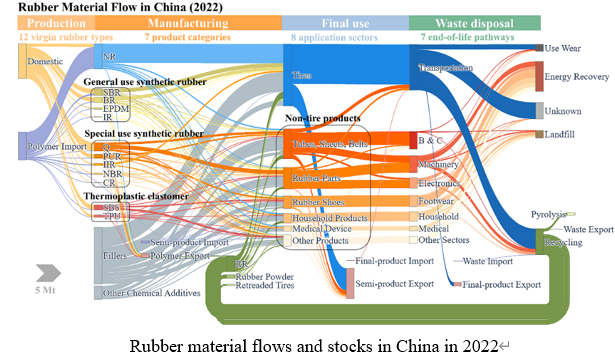
Rubber is a long-lived polymer essential to modern economies, but existing assessments focus mainly on tires. As a result, nontire uses such as footwear, gloves, seals, and construction materials remain poorly quantified, leaving a critical gap in understanding their growing contributions to resource demand, stock accumulation, and waste generation. Here, we develop a 45 year dynamic material flow analysis (1978 to 2022) of rubber in China that covers 12 virgin rubber types, 7 product categories, 8 application sectors, and 7 end-of-life pathways. The model also accounts for fillers, chemical additives, and microrubber particle releases during use. Results show by 2022, nontire products reached 22.5 Mt·yr–1 (67% of total consumption), driving rapid growth in special use synthetic rubbers (SSR) and thermoplastic elastomers (TPE). In-use rubber stocks in nontransportation sectors accumulated to 156.2 Mt (89% of the national total), indicating substantial future waste streams. Yet, only 27% of recycled rubber came from nontire products, reflecting persistent barriers in collection, sorting, and processing. These results demonstrate the growing significance of nontire uses and underscore the need for upstream material innovation, clearer classification and statistics, and downstream sector-specific waste management to close rubber loops and reduce environmental pressures.