2026-03-13 北海道大学
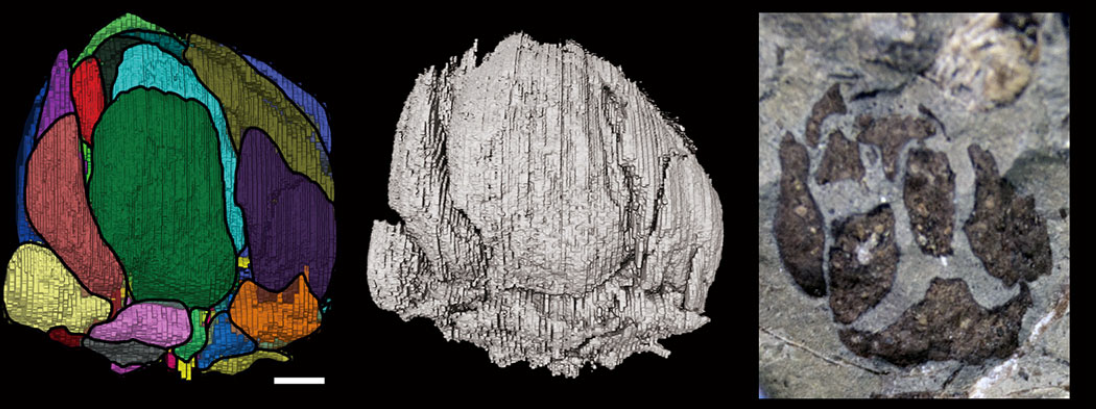
カミキネンスギの球果化石 左、立体構築像(鱗片に着色)/中央、立体構築像/右、実際の化石
<関連情報>
- https://www.hokudai.ac.jp/news/2026/03/post-2215.html
- https://www.hokudai.ac.jp/news/pdf/260313_pr.pdf
- https://www.sciencedirect.com/science/article/abs/pii/S003466672600045X
北海道の上部白亜系から見つかったスギ類の化石球果カミキネンスギ Kamikistrobus primulus gen. et sp. nov., a new taxodioid fossil seed cone from the Upper Cretaceous of Hokkaido, Japan
Songyao Jiang, Toshihiro Yamada
Review of Palaeobotany and Palynology Available online: 21 February 2026
DOI:https://doi.org/10.1016/j.revpalbo.2026.105543
Highlights
- Late Cretaceous seed cone of Kamikistrobus primulus from Hokkaido, Japan.
- Oldest known fossil record of Taxodioideae (Cupressaceae).
- Shows a mosaic of characters seen in living taxodioid genera.
- Cone scales are peltate as in Taxodium, but persistent.
- Persistent scales may indicate different habitat preferences than Taxodium.
Abstract
Kamikistrobus primulus gen. et sp. nov. is described as the earliest known fossil member of Taxodioideae (Cupressaceae), based on seed cones from the Upper Cretaceous (middle–upper Turonian) of Hokkaido, Japan. This fossil shares several key morphological features with Taxodium, including a shortened cone axis, peltate bract–scale complexes with lobed ovuliferous scales, and a single vascular bundle supplying each complex. In contrast, it clearly differs from Taxodium in possessing persistent bract–scale complexes with a rectangular escutcheon, a condition more reminiscent of Cryptomeria and Glyptostrobus. Phylogenetic analyses based on 68 morphological characters place K. primulus as sister to extant genera of Taxodioideae. These results suggest that the character states found in K. primulus are ancestral, and that further specializations arose in the course of diversification of the extant genera. In Taxodium, the deciduous bract–scale complexes facilitate seed dispersal from tightly sealed cones and may represent an adaptation to water-limited conditions. By contrast, the occurrence of K. primulus with persistent bract–scale complexes suggests that early taxodioid conifers had not yet been exposed to, or had not yet evolved in response to, comparable selective pressures.