2026-03-12 東京科学大学
<関連情報>
ランタン酸水素化物担持金属ナノ粒子触媒上での光誘起アンモニア合成 Photoinduced Ammonia Synthesis over Lanthanum Oxyhydride-Supported Metal Nanoparticle Catalysts
Ryosuke Abe,Takuya Nakao,Keiga Fukui,Soshi Iimura,Kiya Ogasawara,Masato Sasase,Masayoshi Miyazaki,Hideo Hosono,and Masaaki Kitano
Journal of the American Chemical Society Published: February 19, 2026
DOI:https://doi.org/10.1021/jacs.5c19134
Abstract
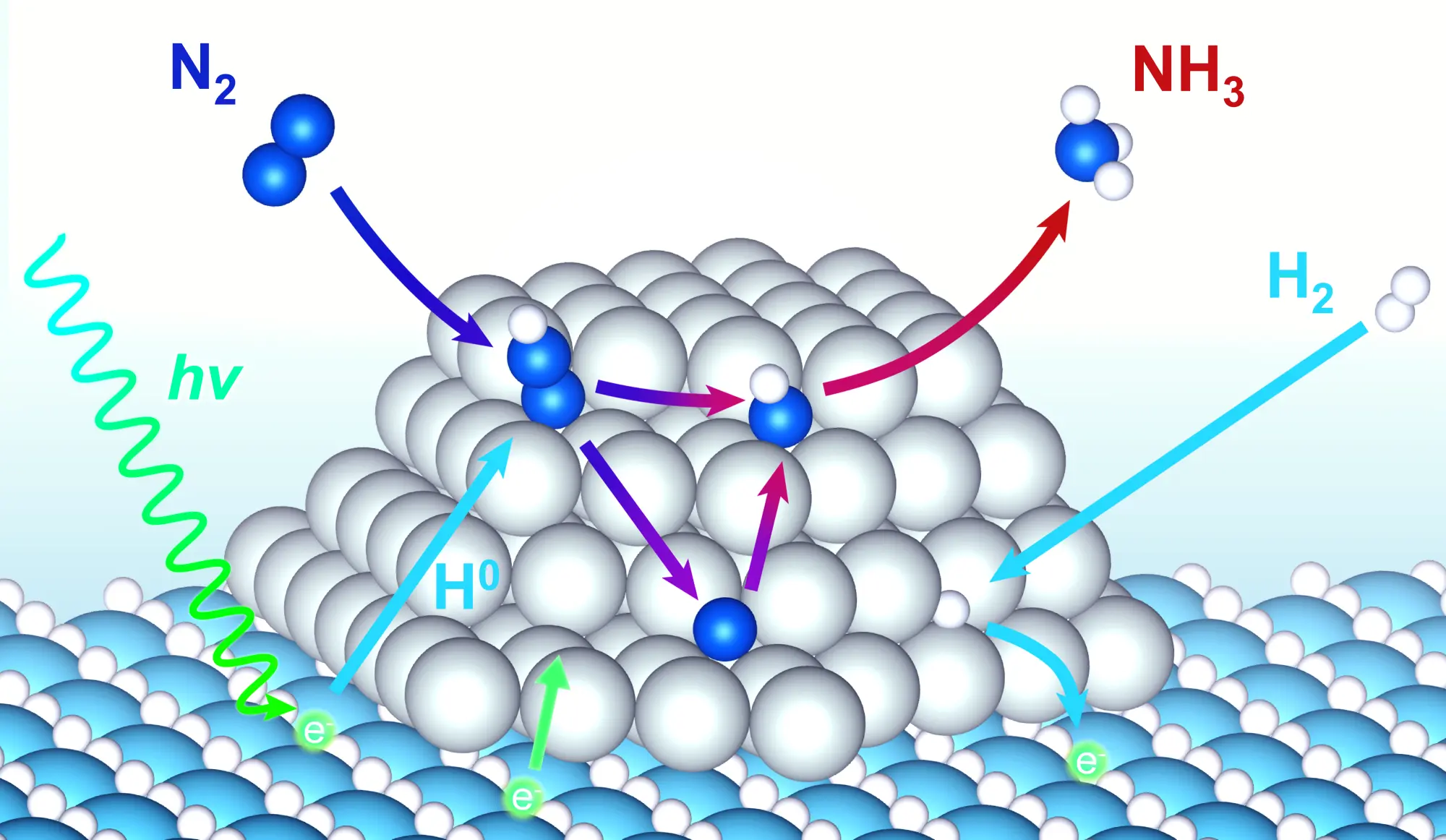
Hydride materials have a significant ability to promote ammonia synthesis over supported transition metal (TM) nanoparticles due to the unique properties of lattice H– ions. Here, we report that lanthanum oxyhydride (LaH3–2xOx) facilitates ammonia synthesis on the supported TM catalyst under visible light irradiation. Ru-loaded LaH3–2xOx exhibited an order of magnitude higher ammonia synthesis rate at 180 °C with an ∼18 kJ mol–1 lower activation energy under visible light irradiation (λ = 405 nm, 1.04 W cm–2) than that under dark conditions. The enhanced catalytic performance can be explained by photoionization of H– (H– → H0 + e–) constituting the valence band maximum (VBM) of LaH3–2xOx, in which photogenerated electrons are transferred to supported Ru, and neutral hydrogen (H0) facilitates the hydrogenation of nitrogen species. Moreover, the photoexcitation of LaH3–2xOx enables shifting of the optimum TM catalyst from Ru to Ni in the volcano-shaped relationship between ammonia synthesis activity and metal–nitrogen binding energy.