2026-03-10 中国科学院(CAS)
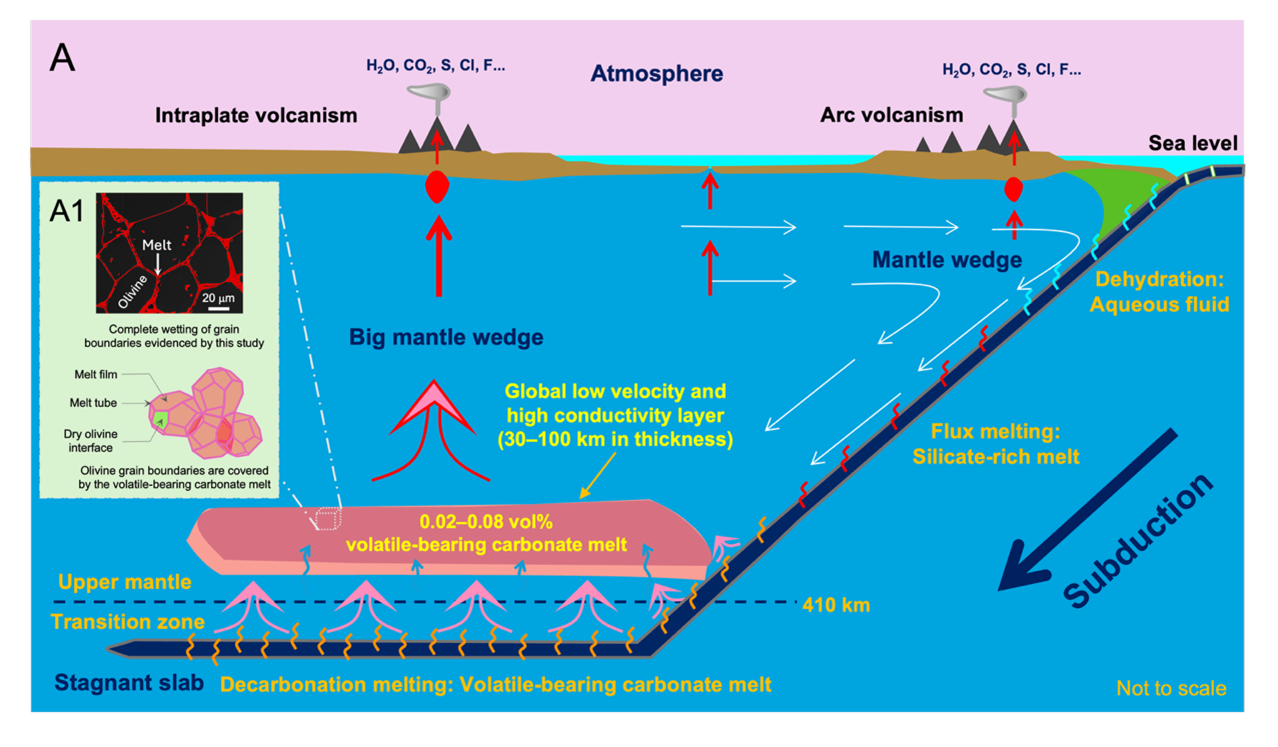
Schematic illustration of a pervasive volatile‑charged carbonate melt network percolating through the upper mantle, promoting global material cycling. (Image by HUANG Yongsheng et al.)
<関連情報>
- https://english.cas.cn/newsroom/research-news/202603/t20260310_1152360.shtml
- https://www.science.org/doi/10.1126/sciadv.aec1018
揮発性物質を帯びた炭酸塩メルトと結びついた上部マントル低速度層 Upper mantle low-velocity layer tied to volatile-charged carbonate melts
Yongsheng Huang, Guoji Wu, Xuran Liang, Kaiwei Tao, […] , and Yuan Li
Science Advances Published:25 Feb 2026
Abstract
Recent geophysical observations indicate the presence of small-volume, carbonate-rich melts in Earth’s deep interior. However, the mechanisms by which such minute melt fractions migrate through largely solid rocks and generate large-scale geophysical anomalies have remained unclear. Here, our high-pressure experiments demonstrate that, in the presence of H2O and NaCl, carbonate-rich melts act as super-spreaders, completely wetting and coating the surfaces of surrounding mantle minerals. This perfect wetting enables even trace amounts of melt (0.02 to 0.08 vol%) to form fully interconnected networks. Such connectivity facilitates efficient melt migration and chemical exchange, driving global material recycling between the surface and planetary interior.