2026-03-10 国際農林水産業研究センター
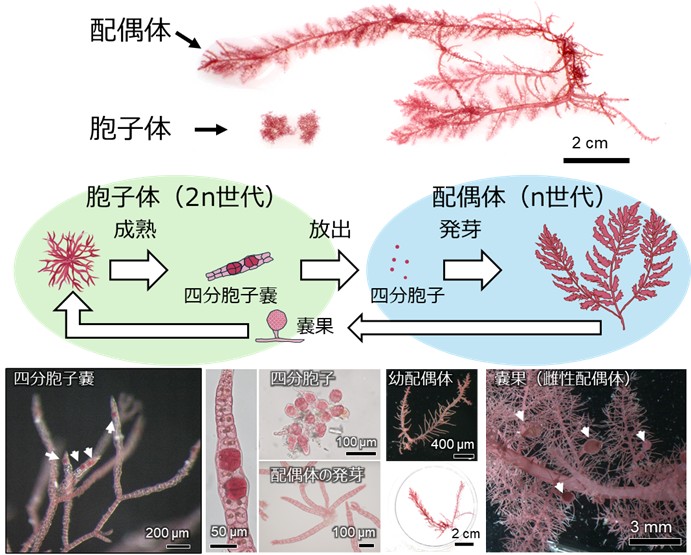
図1 カギケノリの生活環
<関連情報>
- https://www.jircas.go.jp/ja/release/2025/press202527
- https://link.springer.com/article/10.1007/s10126-025-10493-2
実験室環境における紅藻Asparagopsis taxiformisのブロモホルム産生配偶体培養の実証 A Demonstration of Bromoform-Producing Gametophyte Culture for a Red Alga, Asparagopsis taxiformis in Laboratory Conditions
Ryuya Matsuda & Kazuyoshi Kuwano
Marine Biotechnology Published:21 July 2025
DOI:https://doi.org/10.1007/s10126-025-10493-2
Abstract
Asparagopsis taxiformis is a seaweed of interest for use as a livestock feed ingredient because of its high bromoform content, effectively reducing methane emissions from ruminants. A reliable protocol covering hatchery and nursery phases is essential to develop aquaculture techniques for gametophytes. The aim of this study was to establish a seedling production method for gametophytes under controlled laboratory conditions. We conducted the following: (1) induction of tetraspore release, (2) assessment of juvenile gametophyte growth, and (3) evaluation of gametophyte quality through bromoform quantification. Tetraspore release was successfully induced at 25 °C under an equinox photoperiod (12 h light: 12 h dark) or at 20 °C under short photoperiod (8 h light: 16 h dark), with initial spore release occurring after 12.3 ± 1.03 and 15.1 ± 1.26 days, respectively. Germinated tetraspores developed into 3–5 cm gametophytes over 2 months through static culture, followed by an aeration phase using natural seawater. Artificial seawater failed to promote gametophyte growth. Aeration improved the daily growth rate (6.86 ± 0.36%) compared to that of the static culture (4.72 ± 0.51%). Further cultivation promoted the development of main axes, lateral branches, and rhizomes. Bromoform was predominantly accumulated in the lateral branches (17.8 ± 12.3 mg·g−1 dry weight (DW)) and rhizomes (12.2 ± 1.37 mg·g−1 DW), compared to main axes (5.27 ± 1.95 mg·g−1 DW). Unlike tetrasporophytes, which constantly released bromoforms into the medium, gametophytes maintained stable extracellular bromoform levels. These findings demonstrate a feasible approach for laboratory-scale production of A. taxiformis gametophytes with consistent bromoform accumulation, contributing to the advancement of its aquaculture.