2026-03-04 ペンシルベニア州立大学(Penn State)
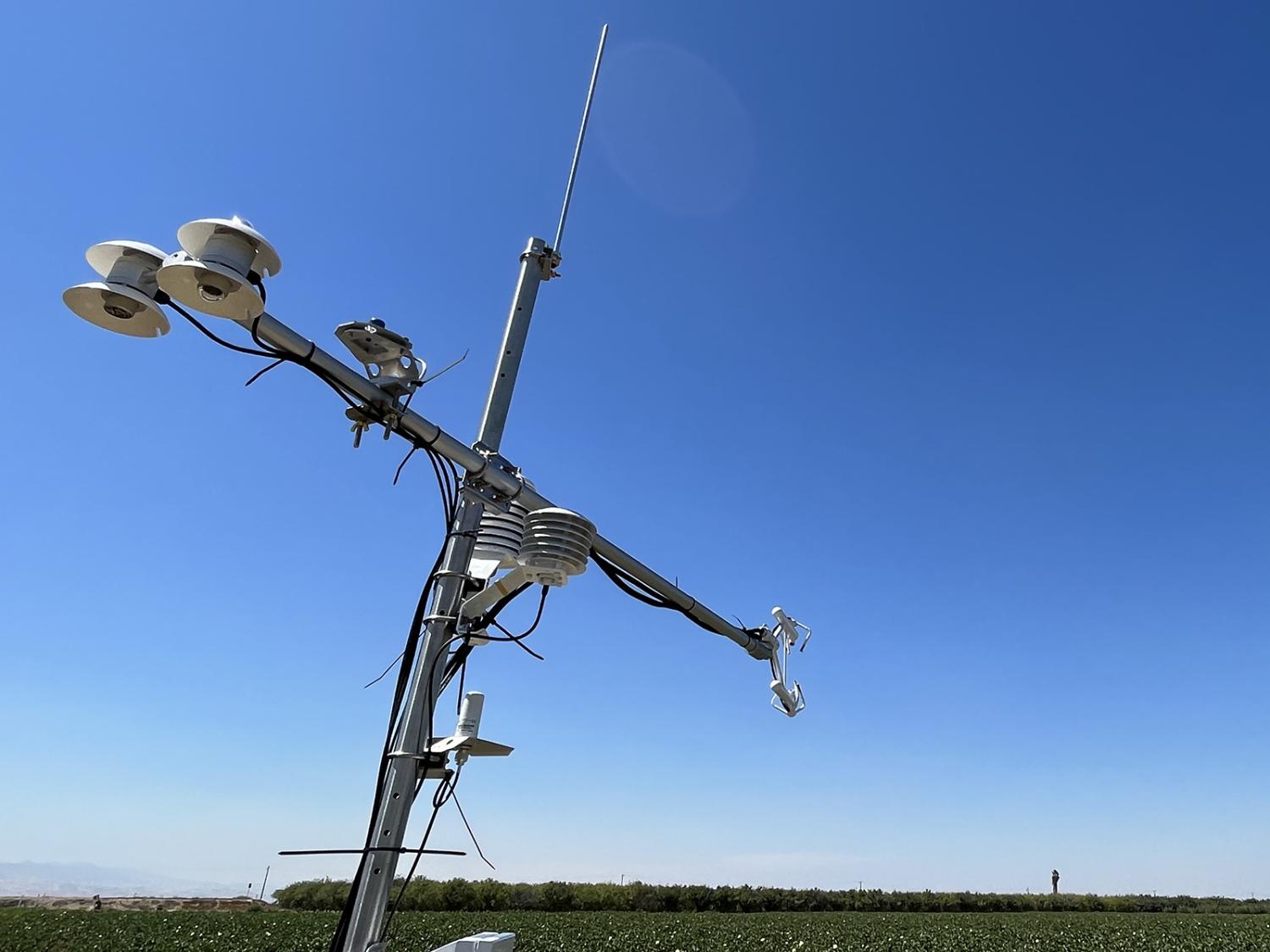
An eddy-covariance flux tower near irrigated cotton fields in San Joaquin Valley was installed in August 2023 at the University of California Agriculture and Natural Resources experimental fields to continuously measure exchanges of heat, moisture and momentum between the land surface and atmosphere. Credit: Fan Wu. All Rights Reserved.
<関連情報>
- https://www.psu.edu/news/research/story/irrigation-gaps-weather-models-could-skew-air-quality-forecasts-study-finds
- https://www.sciencedirect.com/science/article/abs/pii/S0168192326000146
米国西部および東部における渦共分散フラックス測定を用いたWRFにおける表面フラックスの評価 Evaluating surface fluxes in WRF using eddy-covariance flux measurements in the Western and Eastern U.S.
Fan Wu, Kenneth J. Davis, Li Zhang, Ray G. Anderson, Jason P. Horne Sarah Goslee, William Munger, Chenxia Cai, Yu Yan Cui, Zhan Zhao, Min Zhong
Agricultural and Forest Meteorology Available online: 3 February 2026
DOI:https://doi.org/10.1016/j.agrformet.2026.111029
Highlights
- WRF PX LSM overestimates H and underestimates LE over irrigated lands in CA.
- Heat flux biases in CA are linked to missing irrigation in the land surface model.
- PX LSM shows moderate, land-dependent energy partitioning biases in the Mid-Atlantic.
- Momentum flux is overestimated in the day and regionally biased at night.
- Sixteen year-long EC tower data used to evaluate state agencies’ WRF configurations.
Abstract
Atmospheric boundary layer simulations in weather models, important elements of air quality simulations, are coupled with land surface parameterizations. The San Joaquin Valley (SJV) of California and the Multi-state Mid-Atlantic (MMA) feature diverse land uses, including agriculture, urban areas, and forests, which pose challenges for simulating surface fluxes. This study evaluates surface fluxes in the Weather Research and Forecasting (WRF) model using physical configurations adopted by state air quality agencies in California and Pennsylvania. We compared WRF simulations with year-long eddy-covariance flux measurements from 16 sites across the two regions. Results show that the Pleim-Xiu land surface model (PX LSM) exhibits substantial heat flux biases in the SJV but lacks systematic biases in the MMA. In the SJV, the model overestimates daytime (10:00-16:00 LST) sensible heat flux (H) by 260 W m-2 (274%) and underestimates latent heat flux (LE) by 200 W m-2 (68%) at irrigated croplands and orchards during spring and summer. In the MMA, PX LSM moderately overestimates both H and LE, with stronger partitioning into H over urban surfaces and into LE over vegetation. Daytime momentum fluxes are overestimated in both regions, while nighttime biases are inconsistent. Our findings suggest that in the SJV, heat flux biases are strongly associated with irrigation during the growing season, while in the MMA, model-data residuals are limited to modest errors in the Bowen ratio and depend on land cover. Improving WRF’s representation of irrigation and land use, potentially through satellite remote sensing, may enhance surface flux simulation accuracy.