2026-02-27 東北大学
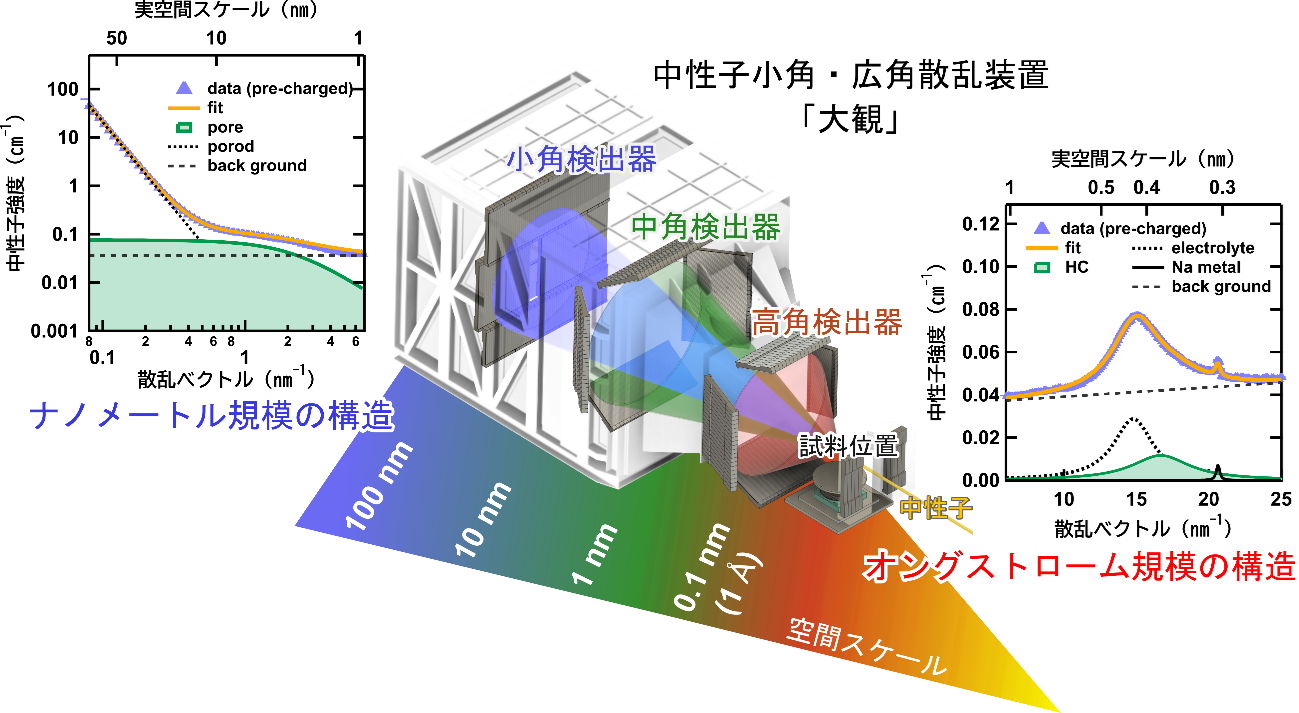
図1 中性子小角・広角散乱装置「大観」の外観と「大観」で観測されるマルチスケールの様子。
<関連情報>
- https://www.tohoku.ac.jp/japanese/2026/02/press20260227-01-Na.html
- https://www.tohoku.ac.jp/japanese/newimg/pressimg/tohokuuniv-press20260227_01web_Na.pdf
- https://pubs.rsc.org/en/content/articlehtml/2026/sc/d5sc09600f
オペランド小角および広角中性子散乱測定によるハードカーボン中のナトリウム貯蔵に関するマルチスケールの洞察 Multiscale insights into sodium storage in hard carbon from operando small- and wide-angle neutron scattering measurements
Yoshihiko Umemoto, Kazuki Ohishi, Daisuke Igarashi, Ryoichi Tatara, Che-an Lin, Kosuke Nakamoto, Yukihiko Kawamura, Kosuke Hiroi, Shin-ichi Takata, Yusuke Nambu, Yoshitaka Tateyama and Shinichi Komaba
Chemical Science Published:25th February 2026
DOI:https://doi.org/10.1039/D5SC09600F
Abstract
Understanding the sodium (Na) storage mechanism in hard carbon (HC) is critical for the development of high-performance Na-ion batteries, which are a promising alternative to lithium-ion batteries owing to the abundance and low cost of Na. In this study, we investigate the Na storage mechanism in commercial HC using operando small- and wide-angle neutron scattering (SANS and WANS). The experiments cover a wide range of scattering vectors, enabling the simultaneous observation of the structural evolution of nanoporous regions and graphene layers during electrochemical charging. Both SANS and WANS analyses reveal that Na storage proceeds sequentially via initial surface adsorption, subsequent insertion into graphene layers, and final filling of nanopores. These results demonstrate the effectiveness of simultaneous operando SANS and WANS measurements for elucidating the complex, multiscale mechanisms of Na storage in HC.