2026-02-25 中国科学院(CAS)
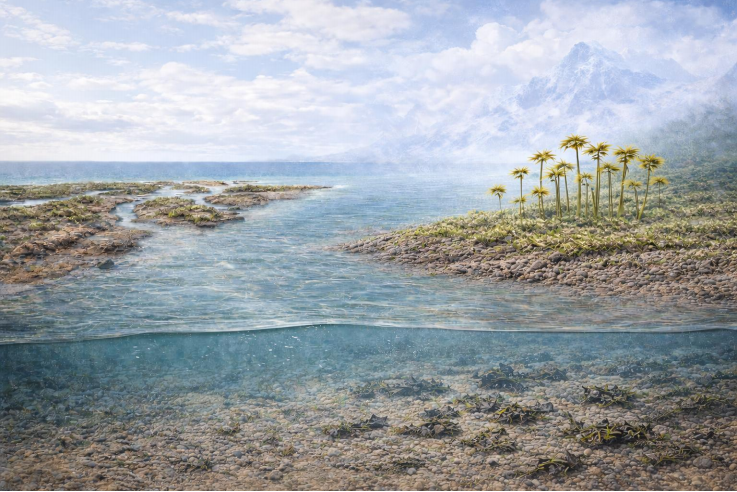
Early land plants reshaping Earth’s surface environments in the Late Ordovician. (Image by CAI Jiachen)
<関連情報>
- https://english.cas.cn/newsroom/research-news/202602/t20260225_1151137.shtml
- https://www.nature.com/articles/s41559-026-02995-6
炭素/リン埋没比は、オルドビス紀後期における陸上植物の急速な拡大を明らかにする Carbon/phosphorus burial ratio reveals a rapid spread of land plants during the Late Ordovician
Jiachen Cai,Lidya G. Tarhan,Timothy M. Lenton,Ruoyuan Qiu,Caroline L. Peacock,Noah J. Planavsky,Pengcheng Ju,Wenjin Zhao,Zhifang Xu,Hui Zhang & Mingyu Zhao
Nature Ecology & Evolution Published:24 February 2026
DOI:https://doi.org/10.1038/s41559-026-02995-6
Abstract
Initial land plant diversification occurred over the Ordovician, Silurian and Devonian periods (~460–360 Ma) and fundamentally transformed Earth’s biosphere and the composition of the oceans and atmosphere. Yet, the exact timing of the impact of land plants on the Earth system remains uncertain. Here we find evidence for a substantial shift in organic carbon to total phosphorus ratios (Corg/Ptotal) in marine siliciclastic strata beginning around 455 million years ago. Building from the prominent observed difference in C/P ratios of modern terrestrial and marine organic matter, we link this change to the initial spread of land plants. Given the common assumption that phosphorus limits global primary productivity and that organic carbon burial regulates atmospheric oxygen levels, this shift is likely to have driven Earth’s surface oxygenation. Palaeogeographic analyses suggest that land plants may have spread in Laurentia earlier than on other palaeocontinents.