2026-02-17 コロンビア大学
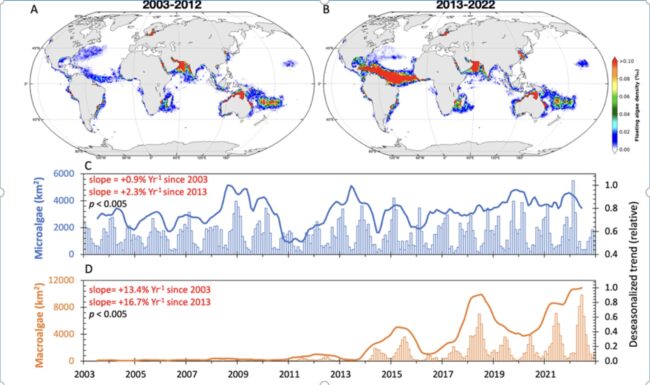
Decadal changes in floating algae. Distributions between 2003 – 2012 (A) and 2013 – 2022 (B). The 20-year changes in algae abundance are shown in (C) for microalgae and (D) for macroalgae, respectively. The year mark starts at January. Both increased significantly in time.
<関連情報>
- https://news.climate.columbia.edu/2026/02/17/harnessing-ai-scientists-discover-a-rise-in-floating-algae-across-the-global-ocean/
- https://www.usf.edu/marine-science/news/2026/scientists-harness-ai-to-discover-a-rise-in-floating-algae-across-the-global-ocean.aspx
- https://www.nature.com/articles/s41467-025-66822-5
世界中で浮遊藻類の大量発生が拡大している Global floating algae blooms are expanding
Lin Qi,Menghua Wang,Brian B. Barnes,Douglas G. Capone,Joaquim I. Goes,Edward J. Carpenter,Yuyuan Xie & Chuanmin Hu
Nature Communications Published:07 December 2025
DOI:https://doi.org/10.1038/s41467-025-66822-5
Abstract
In the past two decades, both microscopic algae (i.e., phytoplankton) and larger algae (i.e., macroalgae) have increased in certain coastal and open ocean waters, yet a comprehensive picture at the global scale is lacking. Here, we address this challenge by analyzing 1.2 million satellite images with computer artificial intelligence to quantify macroalgal mats and microalgal scums in global oceans between 2003 and 2022. With a total cumulative realized niche area of 43.8 million km2, macroalgae blooms in the tropical Atlantic and western Pacific both expanded at unprecedented rates since the 2010s (13.4% per year since 2003). Although slower, the annual expansion rate of microalgae scums is also statistically significant (1.0% per year since 2003). Such trends are likely a result of ocean warming and eutrophication, with a possible regime shift favoring macroalgae and specialized species of microalgae. These findings have broad implications on ocean ecology, carbon sequestration, environments, and economy.