2026-01-07 ラトガース大学
<関連情報>
- https://www.rutgers.edu/news/marine-geoscientists-link-warming-ancient-ocean-salty-blob
- https://www.nature.com/articles/s41561-025-01756-7
氷河期終了期のインド洋における浅海域の塩分濃度上昇は深層水に起因していた Elevated shallow water salinity in the deglacial Indian Ocean was sourced from the deep
Ryan H. Glaubke,Elisabeth L. Sikes,Sindia M. Sosdian,Natalie E. Umling,Aidan Starr,Paola L. Moffa-Sanchez & Matthew W. Schmidt
Nature Geoscience Published:06 August 2025
DOI:https://doi.org/10.1038/s41561-025-01756-7
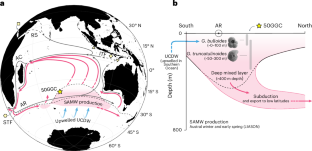
Abstract
Along the northern rim of the Southern Ocean, the transformation of upwelled deep waters into less-dense Subantarctic Mode Waters forms a critical link between the deep and shallow layers of the global ocean. In the Indian sector, mode waters comprise a key component of Agulhas Leakage, which today conveys salt to the Atlantic basin necessary for sustaining deep water formation. The salinity of Indian-sourced mode waters may therefore represent an upstream influence on Atlantic overturning, with implications for global climate. Here we reconstructed the temperature and salinity of these waters across the Last Deglaciation using the geochemistry of two planktic foraminiferal species from a south Indian Ocean sediment core. Approximately 20,000 years ago (~20 ka), deglaciation was marked by an abrupt ~2–2.6 practical salinity unit increase that persisted until ~16 ka. This event coincided with an increase in water mass age reconstructed from the same core. We argue this coherence is evidence for an aged, salty glacial bottom water mass that, once upwelled, modified the salinity of Indian-sourced mode water. Model experiments suggest this salt had the potential, if leaked into the Atlantic, to nudge overturning towards its modern-day configuration, highlighting an underappreciated deep ocean influence on the deglacial dynamics.