2026-02-18 ペンシルベニア州立大学(Penn State)
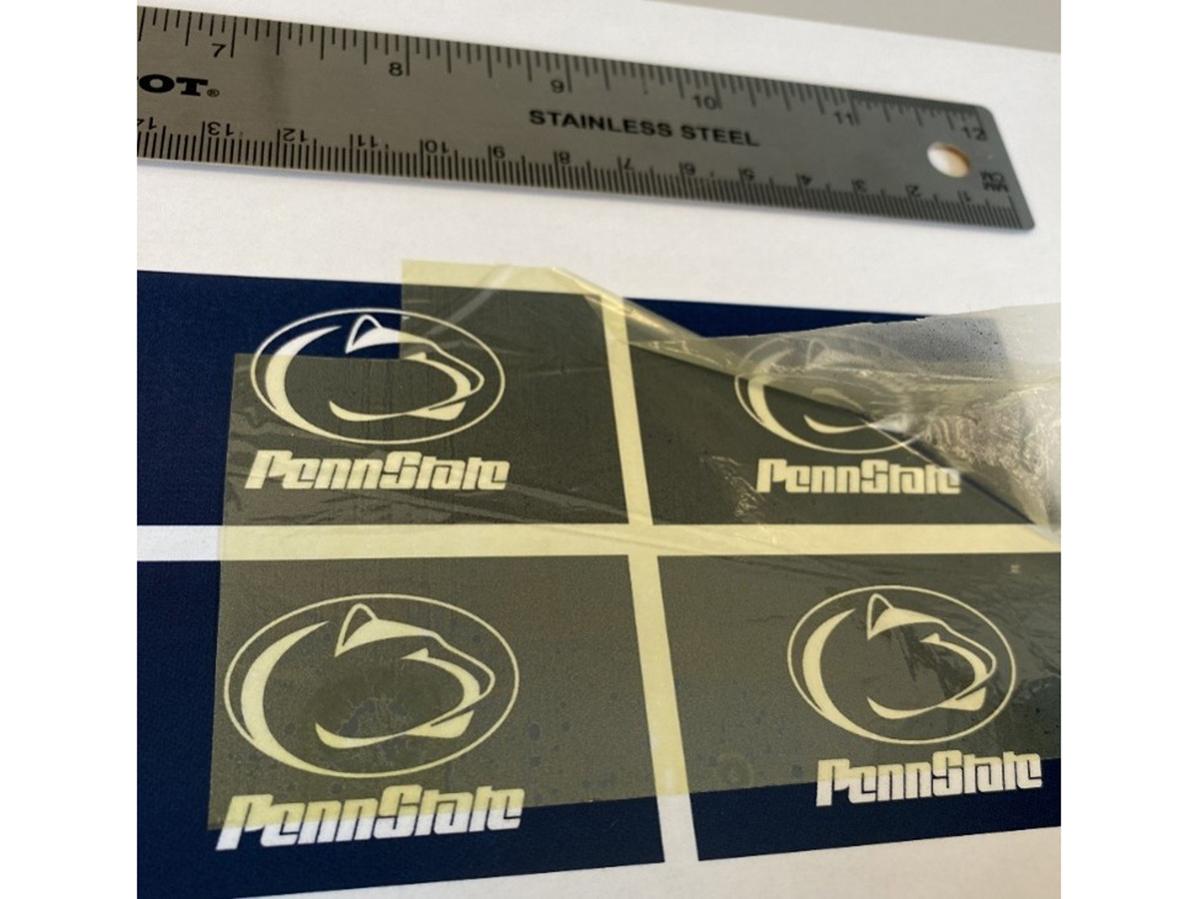
Researchers developed a polymer capacitor by combining two cheap, commercially available plastics. The new polymer capacitor makes use of the transparent material — pictured here, with vintage Penn State athletic marks visible through it — to store four times the energy and withstand significantly more heat. Credit: Provided by the researchers. All Rights Reserved.
<関連情報>
- https://www.psu.edu/news/research/story/new-plastic-material-could-solve-energy-storage-challenge-researchers-report
- https://www.nature.com/articles/s41586-026-10195-2
全ポリマーナノ複合材料における巨大なエネルギー貯蔵と誘電性能 Giant energy storage and dielectric performance in all-polymer nanocomposites
Li Li,Guanchun Rui,Wenyi Zhu,Yiwen Guo,Zitan Huang,Siyu Wu,Riccardo Casalini,Qing Wang,Zi-Kui Liu,Ralph H. Colby,Seong H. Kim,Wenchang Lu,J. Bernholc & Q. M. Zhang
Nature Published:18 February 2026
DOI:https://doi.org/10.1038/s41586-026-10195-2
Abstract
Dielectric polymers used in electrical energy storage require a combination of key metrics, including a high dielectric constant (K), low loss and high breakdown strength (Eb), all while being capable of operating at high temperatures1,2,3,4,5,6. Decades of research into polymer–inorganic composites have achieved only limited success in reaching these goals5,7,8. Here we introduce high-temperature immiscible blends of two dipolar polymers that, through nanophase separation, self-assemble into three-dimensional all-polymer nanocomposites. The resulting nanostructures induce coiled-chain morphology and large conformation changes, which, combined with relatively low rotational barrier and high dipole moments of both polymers, yield ultrahigh dielectric responses (K > 13) while maintaining a low loss (tanδ approximately 0.002) across a wide temperature range. Simultaneously, the nanostructured interfaces act as barriers for mobile charges, markedly reducing conduction losses at high fields and temperatures. The all-polymer three-dimensional nanocomposites with concurrently high K, high Eb and low loss deliver unprecedented discharged energy densities at elevated temperatures (18.7 J cm−3, 15.1 J cm−3 and 8.6 J cm−3 at 150 °C, 200 °C and 250 °C, respectively). The approach is applicable to other immiscible dipolar blends, demonstrating its universality and tunability. This work addresses the urgent needs in electrical energy storage and provides a new paradigm towards high-energy-density polymer dielectrics over a broad temperature range.